Ethiopian coffee: jasmine, bergamot and blueberry
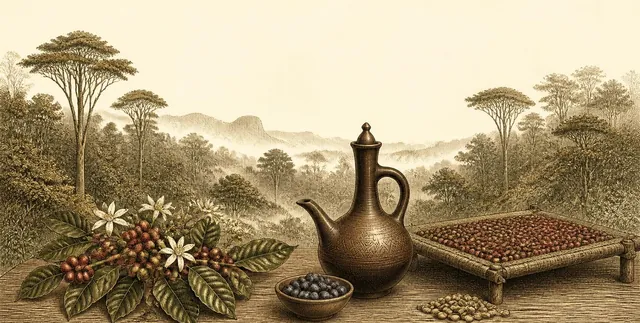
For many people, Ethiopian coffee is the moment they notice that coffee can be more than "strong" or "mild". A cup of washed Yirgacheffe smells of jasmine and tastes of bergamot, a little like a good Earl Grey; a natural from Guji can taste of blueberry jam. That is why an Ethiopian coffee sits in the range of almost every speciality roaster in the UK.
Why is Ethiopia called the home of coffee?
Coffea arabica still grows wild in the mountain forests of south-western Ethiopia. From there coffee travelled to Yemen and on to the rest of the world. That genetic diversity is why Ethiopian coffee can taste so different from one lot to the next, and why the bag often names no single variety.
What does "heirloom" or "Ethiopian landrace" mean?
Ethiopian coffees rarely name a variety such as Bourbon or Typica. Instead the bag says "Heirloom" or "Ethiopian landrace": a collective term for the many local landraces that grow mixed together on smallholdings. Some roasters give numbers such as 74110 or 74112. These are selections made by Ethiopia's national coffee research centre in Jimma. Where roasters on Bean Index name a variety for an Ethiopian coffee (90 coffees), the most frequent entries are Ethiopian Landrace (80%), Heirloom (11%), Local landraces (3%) and Bourbon (2%).
Yirgacheffe, Sidama, Guji: which regions should you know?
Most speciality coffee comes from the south: Sidama (often spelt "Sidamo" on older bags), Yirgacheffe in the Gedeo zone, and Guji. The west supplies coffees from Limu, Jimma and Bench Maji; the east is traditionally known for naturals from Harrar. On Bean Index, the regions UK roasters name most often are Yirgacheffe, Gedeo and Guji. Where roasters give an altitude, the median is 2,200 m above sea level.
As in Kenya, most farmers are smallholders who deliver their cherries to a washing station. That is why an Ethiopian coffee usually carries the name of the station or the village rather than a farm.
Washed or natural?
In washed coffee the fruit is removed before the beans dry; the cup tends to be clean, floral and citrusy. In a natural the whole cherry dries in the sun; the cup becomes fruitier and sweeter, often with berries and sometimes a slightly winey note. Among Ethiopian coffees on Bean Index whose roaster states the process (n = 110), 40% are washed and 54% are natural. Compare washed coffee with natural process coffee, or read how the methods differ in natural vs washed: how they taste.
What does Grade 1 mean?
Ethiopia grades its export coffee mainly by the number of defects found in a sample. Grade 1 (often written G1) is the top grade with the fewest defects; Grade 2 is also common for washed coffees. A Grade 1 is a good sign, but not a promise of flavour: roast and freshness matter just as much. On Bean Index, 4 Ethiopian coffees mention Grade 1 in the product name; we only search the name, so more lots may be Grade 1 without saying so.
| On the bag | What it tells you |
|---|---|
| Heirloom, Ethiopian landrace | A mix of local landraces, not one named variety. |
| 74110, 74112 | Selections from the national research centre in Jimma. |
| Station or village name | Where many smallholders delivered their cherries, not a single farm. |
| Washed, natural | How the fruit was removed: clean and floral, or fruity and sweet. |
| Grade 1, Grade 2 (G1, G2) | Export grade by defects in a sample; says nothing about roast or freshness. |
What does Ethiopian coffee taste like?
Roasters often describe washed Ethiopian coffees with jasmine, bergamot, lemon, peach and black tea, and naturals with blueberry, strawberry, ripe stone fruit and chocolate. For 46% of the Ethiopian coffees on Bean Index the roaster's notes read floral and tea-like, for 37% citrusy and for 34% of berries. If you have never had a "floral" coffee, Ethiopia is a good place to start; see floral coffee beans. Why fruity does not have to mean sharp is explained in fruity is not the same as sour.
Filter or espresso?
The delicate floral and tea notes come through most clearly in pour-over and filter, which is why many roasters roast Ethiopian coffees light, for filter. Of the Ethiopian coffees whose roaster states a brew method (n = 59), 19% are roasted for espresso, alone or as an omni roast. Naturals also work as a fruity espresso or in a flat white, where the berry notes with milk can recall strawberry yoghurt. How light "light" really is: light roast coffee: when is light really light? Water matters as well, because much of the UK has hard water: see water for coffee.
What does Ethiopian coffee cost?
Ethiopia covers a wide range, from inexpensive Grade 2 coffees to small lots from single farmers and competition lots. On Bean Index, the median for Ethiopia is £59/kg, and for all single origins £54/kg (price per kg from the standard bag, checked 19 Oct 2026). The graphic shows how the countries compare. For Ethiopia's East African neighbour, see Kenyan coffee.
| Origin | Range p10–p90 | Median | n |
|---|---|---|---|
| Colombia | £39–104/kg | £55/kg | 233 |
| Brazil | £36–63/kg | £45/kg | 116 |
| Ethiopia | £40–80/kg | £59/kg | 117 |
| Kenya | £42–68/kg | £58/kg | 75 |
| Guatemala | £40–74/kg | £55/kg | 68 |
| Peru | £42–74/kg | £58/kg | 55 |
| Costa Rica | £38–73/kg | £54/kg | 41 |
| Rwanda | £38–68/kg | £51/kg | 38 |
| Honduras | £38–70/kg | £53/kg | 38 |
| Mexico | £41–66/kg | £52/kg | 32 |
What we don't know
- Which landraces are in the bag. "Heirloom" is a collective term; often even the farmers do not know exactly what grows on their land.
- How good a particular lot is. We take grades and scores as the roaster states them and do not check them.
- How it tastes to you. Roast, freshness, water and recipe make a big difference, especially with delicate Ethiopian coffees.
Ethiopian coffees on Bean Index
Origin CoffeePorthleven, UK
Arsosala
Ethiopia, Uraga, 1,800–1,900 m
Washed, Ethiopian Landrace
Floral & tea, Citrus, Berries
Espresso roast
Price per kg £58.80/kg
£14.70 for 250 g, excl. delivery, checked
around the median for Washed from Ethiopia
To roasterOvenbird CoffeeGlasgow, UK
Ethiopia Yirgachefe G1 Chelelektu
Ethiopia, Yirgacheffe, 1,800 m
Natural, Ethiopian Landrace
Floral & tea, Tropical & winey
Omni roast
Price per kg £42.00/kg
£21.00 for 500 g, excl. delivery, checked
Redemption RoastersLondon, UK
Gerse
Ethiopia, Yirgacheffe, 2,000–2,200 m
Washed, Ethiopian Landrace
Berries, Nut & caramel
Filter roast
Price per kg £67.00/kg
£16.75 for 250 g, excl. delivery, checked
16% above median for Washed from Ethiopia
To roasterWogan CoffeeBristol, UK
Ethiopia, Yirgacheffe Natural, Nensebo Mundayo
Ethiopia, Yirgacheffe, 1,945–2,100 m
Natural, Heirloom
Floral & tea, Citrus, Nut & caramel
Omni roast
Price per kg £36.00/kg
£9.00 for 250 g, excl. delivery, checked
42% below median for Natural from Ethiopia
To roasterAnonymous CoffeePeppard Common, UK
Ethiopia, Dumerso, Washed
Ethiopia, Yirgacheffe, 1,800–2,000 m
Washed, Ethiopian Landrace
Floral & tea, Citrus, Nut & caramel
Omni roast
Price per kg £38.00/kg
£9.50 for 250 g, excl. delivery, checked
34% below median for Washed from Ethiopia
To roasterAssembly CoffeeLondon, UK
Ethiopia — Duwancho
Ethiopia, Sidama, 1,920–2,020 m
Natural, Ethiopian Landrace
Floral & tea, Citrus
Espresso roast
Price per kg £72.50/kg
£14.50 for 200 g, excl. delivery, checked
17% above median for Natural from Ethiopia
To roasterAll Ethiopian coffee beans · Ethiopian naturals · Washed Ethiopian coffees
Sources & method
- Origin, landraces, regions, processing and grades in Ethiopia: generally accepted knowledge from roaster and trade literature. Varieties 74110 and 74112: World Coffee Research, Arabica coffee varieties catalogue (varieties.worldcoffeeresearch.org).
- Origin, region, variety, altitude and process: as stated by the roasters in their shops; shares refer to coffees for which the field is stated. Rules: methodology.
- Flavour notes: read by AI from the roasters' descriptions, not a measurement.
- Figures from Bean Index: coffees on sale, n = 1,510, from 111 UK roasters, checked 19 Oct 2026.
This guide is also available in German: Kaffee aus Äthiopien: Jasmin, Bergamotte und Blaubeere (Bohnenatlas)