Natural vs washed coffee: how they taste and what they cost
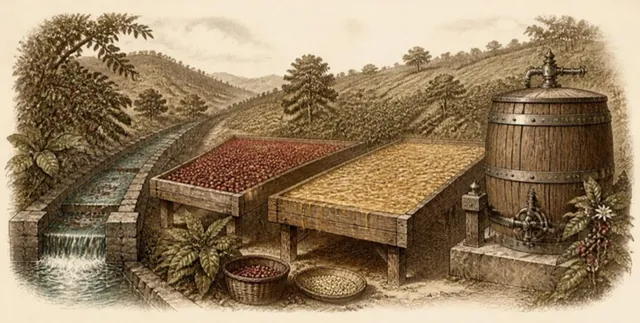
A coffee bean is the seed of a cherry. Under the thin skin there is sweet fruit pulp, then a sticky layer of mucilage, then a papery parchment and a fine silver skin. Inside sit two seeds: the beans. Processing is everything that happens between picking and green coffee that can be stored and shipped. The seeds are separated from the fruit and dried down to roughly 10 to 12% moisture.
How a farm or washing station does this changes the taste a lot. The same farm can turn one harvest into two quite different coffees by processing it two ways, which is why UK roasters print the process on the bag next to origin and variety.
What happens in washed processing?
Washed (also called wet processed) coffee is pulped soon after picking: a machine squeezes the seeds out of skin and fruit. The sticky mucilage that remains is broken down by fermentation in tanks, where yeasts and bacteria do the work over hours or days depending on the climate. The beans are then washed clean and dried in their parchment on patios, raised beds or in mechanical dryers.
Because little fruit stays on the bean for long, washed coffees are usually described as clean and clear. Roasters often mention bright acidity, citrus or florals, and origin and variety come through more distinctly. Washed is the usual method in Colombia, Kenya and much of Central America, and many Ethiopian washing stations work this way too. It needs a lot of water and equipment.
In Bean Index, 557 coffees from 103 roasters are labelled washed. Compare washed coffees from UK roasters.
What happens in natural processing?
Natural (also dry processed) is the oldest method. The whole cherry dries in the sun for several weeks, spread thinly on patios or raised beds. It has to be turned regularly so nothing goes mouldy or ferments out of control. At the end the cherries are dark and wrinkled like raisins, and only then is the dried husk milled off.
Because the fruit stays on the seed for so long, naturals are often fruitier and sweeter, with a heavier body. Tasting notes lean towards berries, tropical fruit or wine. Natural processing is traditional in Ethiopia, Yemen and Brazil. It uses very little water, but it is unforgiving: unevenly dried cherries can taste over-fermented or musty.
427 coffees from 102 roasters are labelled natural. See natural process coffee side by side.
Is honey process in between?
Yes. In honey processing the skin and fruit are removed as for washed coffee, but some or all of the sticky mucilage stays on the bean while it dries. The name comes from that tacky layer, called "miel" in Central America; no honey is involved. Brazil has a related method called pulped natural.
Names like yellow, red or black honey roughly describe how much mucilage is left and how slowly the beans dry: the more and the slower, the darker the name. The terms are not standardised. Roasters often describe honey coffees as sweet and rounded, with less fruit than a natural and softer acidity than a washed. The method is common in Costa Rica and El Salvador.
A note on our data: we only count "honey" as a process when it appears in the product name or a labelled field. In a description it is usually a flavour note. That gives 77 honey process coffees from 44 roasters.
What are anaerobic and infused coffees?
Anaerobic means without oxygen. Cherries or pulped beans ferment in sealed tanks, often for several days, and are then dried as a natural, washed or honey. That is why Bean Index treats anaerobic as an addition to the process and shows it as, for example, "Natural (anaerobic)". Carbonic maceration is a variant borrowed from winemaking: the tank is flushed with carbon dioxide.
Anaerobic coffees are often described in loud terms: winey, boozy, tropical, sometimes cinnamon or spice. They divide opinion. Some people look for exactly that; others find it too much.
Infused coffee goes a step further: fruit, spices, yeasts or flavourings are added during fermentation. Whether that is still the taste of the origin or already flavoured coffee is argued about in speciality coffee. What matters is that it is declared. We mark a coffee as infused when the roaster says so, and the process filter in the catalogue can leave infused coffees out. Not every roaster mentions it.
There are regional methods too, such as wet hulling in Indonesia, where the parchment is removed while the beans are still wet. Roasters tend to describe these coffees as earthy, spicy and heavy.
Roasters call 105 coffees from 50 roasters anaerobic, and 45 are labelled infused (checked 19 Oct 2026). Browse anaerobic and infused lots.
How do they taste and what do they cost?
The table shows, for each process, how many coffees we list, the median price per kg, the range in which four out of five coffees fall (one in ten is cheaper, one in ten dearer) and the flavour families roasters mention most often. Flavour notes are the roasters' words, read by AI and grouped into eight families; they are not a measurement.
| Process | Coffees | Roasters | Median | Range (p10–p90) | Most frequent flavour families |
|---|---|---|---|---|---|
| Washed | 557 | 103 | £54/kg | £40–74/kg | Nut & caramel, Chocolate and Citrus |
| Honey | 77 | 44 | £55/kg | £36–76/kg | Nut & caramel, Chocolate and Stone fruit |
| Natural | 427 | 102 | £52/kg | £40–80/kg | Nut & caramel, Chocolate and Berries |
| Anaerobic (any base process) | 105 | 50 | £68/kg | £50–117/kg | Tropical & winey, Berries and Nut & caramel |
| Infused | 45 | 28 | £88/kg | £57–121/kg | Floral & tea, Citrus and Nut & caramel |
| Process | Range p10–p90 | Median | n |
|---|---|---|---|
| Washed | £40–74/kg | £54/kg | 530 |
| Honey | £36–76/kg | £55/kg | 70 |
| Natural | £40–80/kg | £52/kg | 390 |
| Anaerobic | £50–117/kg | £68/kg | 94 |
- Washed · n = 464
- Honey · n = 66
- Natural · n = 360
- Anaerobic · n = 90
The differences are tendencies. Variety, altitude, roast and the work on the farm shape the cup as well: a light washed Ethiopian can taste fruitier than a darker natural from Brazil. Why a fruity coffee need not taste sharp is explained in fruity is not the same as sour.
More elaborate methods mean more work and more risk at the farm: a failed fermentation cannot be rescued, and experimental lots are often small. Both can show in the price. Process explains only part of it, though; origin, variety and the roaster matter too. More in how much speciality coffee costs per kg.
What we don't know
- How the coffee was really processed. We take the roaster's word, which usually comes from the farm or importer. Where nothing is stated, the coffee page says "not stated by the roaster".
- What the labels mean in detail. Honey, anaerobic and infused are not legally defined, and farms use them differently. Fermentation times and temperatures are rarely published.
- How it tastes to you. Flavour families tell you the direction a roaster describes, not what ends up in your cup.
Natural coffees in Bean Index
Outpost CoffeeNottingham, UK
BROKEN PROMISE 001 / 72hr Anaerobic Natural / Uganda
Uganda, Mt. Elgon, 1,900 m
Natural (anaerobic), SL28, SL34
Citrus, Tropical & winey, Stone fruit
Omni roast
Price per kg £80.00/kg
£16.00 for 200 g, excl. delivery, checked
77% above median for Natural from Uganda
To roasterOvenbird CoffeeGlasgow, UK
Ethiopia Yirgachefe G1 Chelelektu
Ethiopia, Yirgacheffe, 1,800 m
Natural, Ethiopian Landrace
Floral & tea, Tropical & winey
Omni roast
Price per kg £42.00/kg
£21.00 for 500 g, excl. delivery, checked
Pharmacie Coffee RoastersLewes, UK
Carlos Mejia, Honduras
Honduras, La Paz, 1,450 m
Natural, Catuai
Tropical & winey, Nut & caramel
Filter & espresso roast
Price per kg £48.00/kg
£12.00 for 250 g, excl. delivery, checked
15% below median for Natural from Honduras
To roasterRoastworks Coffee Co.Willand, UK
Brazil
Brazil, Minas Gerais, 1,150 m
Natural, Catuai
Dried fruit & spice, Chocolate, Nut & caramel
Filter roast
Price per kg £42.50/kg
£8.50 for 200 g, excl. delivery, checked
around the median for Natural from Brazil
To roasterThe Good Coffee CartelGlasgow, UK
Brazil, Sitio Penha
Brazil, Nova Resende, 1,110 m
Natural, Catuai
Dried fruit & spice, Nut & caramel
Espresso roast
Price per kg £40.00/kg
£8.00 for 200 g, excl. delivery, checked
9% below median for Natural from Brazil
To roasterUe Coffee RoastersWitney, UK
Brazil Aracacu Catucai Microlot
Brazil, Minas Gerais, 1,000–1,200 m
Natural, Catuai, Mundo Novo
Tropical & winey, Nut & caramel, Stone fruit
Omni roast
Price per kg £48.00/kg
£12.00 for 250 g, excl. delivery, checked
9% above median for Natural from Brazil
To roasterSources & method
- Process: from the roasters' own shops. Labelled fields and product names take priority over description text; the source is shown on every coffee. Rules: methodology.
- Prices: price per kg from the standard bag (200 to 350 g), coffees currently on sale, checked 19 Oct 2026. Groups are shown only from five coffees by three roasters. Prices in other currencies converted at the ECB reference rate of 19 Oct 2026.
- Flavour notes: read by AI from the roasters' descriptions, not a measurement. Roasters give flavour notes for 79% of the coffees.
- Processing in general: training material of the Specialty Coffee Association (SCA, sca.coffee). Terms such as honey or anaerobic are not regulated and are used differently by farms.
This guide is also available in German: Natural, Washed, Honey, Anaerob: Aufbereitung erklärt – mit Zahlen aus dem Atlas (Bohnenatlas)