Fruity is not sour: what coffee flavour notes mean
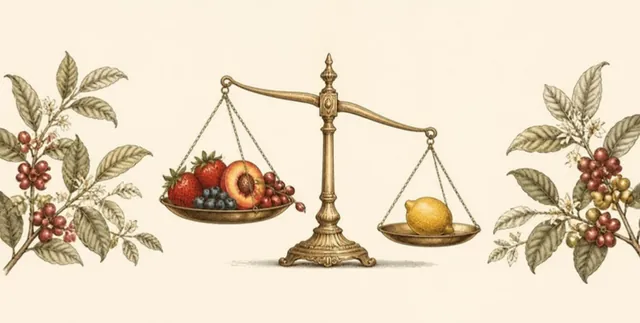
Fruity, sour, bitter: what is the difference?
Your tongue tastes five basic qualities: sweet, sour, salty, bitter and umami. Everything else, strawberry, jasmine, hazelnut, you perceive through your nose, even while drinking, as aromas rise from the back of the mouth into the nasal cavity. That is aroma.
So "fruity" describes aroma and "sour" describes taste. They can come together, but they don't have to. One coffee can smell of ripe berries and taste sweet and round; another can taste sharply sour and smell of nothing in particular.
Acidity is part of coffee. The bean contains organic acids such as citric, malic and chlorogenic acids. In a well-brewed cup, acidity feels lively because sweetness carries it; tasters call it bright or clean. Coffee tastes unpleasantly sour mostly when the sweetness is missing. Bitterness comes mainly from dark roasting and from extracting too much from the grounds.
What do roasters mean by berry, citrus and stone fruit?
Tasting notes are comparisons. "Strawberry, cocoa, jasmine" does not mean anything was added; it means the roaster was reminded of those things when tasting. Many terms come from the Coffee Taster's Flavor Wheel of the Specialty Coffee Association (SCA), revised in 2016 with World Coffee Research. They are a shared vocabulary, not a measurement.
The exception is infused coffee, where fruit, spices or flavourings are added during fermentation. There the strawberry may really come from a strawberry. We mark such coffees when the roaster says so, and the catalogue can leave them out.
Some patterns come up again and again. They are tendencies, not rules:
- Citrus (lemon, lime, grapefruit, bergamot) is often named for washed coffees from East Africa.
- Berries and tropical fruit cluster around natural coffees, dried inside the whole cherry.
- Stone fruit (peach, apricot, cherry) often stands for soft, juicy acidity.
- Chocolate, nut and caramel describe sweetness and roast flavours. They are common with darker roasts and with many coffees from Brazil.
Two roasters often describe the same green coffee differently. The notes tell you the direction a coffee goes, not how it will taste in your cup. How process shapes those notes is in natural vs washed: how they taste.
How does Bean Index read the notes?
We don't copy notes word for word. AI reads each roaster's description and sorts the flavours into eight families: floral & tea, citrus, berries, tropical & winey, dried fruit & spice, chocolate, nut & caramel, and stone fruit. These are the petals of the flavour seal on every card. A full petal means the family is named; it says nothing about intensity, because no note states that reliably.
From the families we derive the flavour axis. If citrus, berries, florals, tea, tropical or stone fruit dominate, the coffee sits on the "fruity and bright" side; if chocolate, nut, roast or spice dominate, on the "chocolatey & nutty" side; in between is "balanced". The formula is in the methodology.
Two caveats. The axis is derived from words, not measured, and the AI can misread. Every such value is labelled as read by AI, and you can report a mistake. We deliberately have no acidity scale: how acidic a coffee tastes is not stated by the roasters, so we do not filter by it.
The roast's intended use makes a difference. Of the roasts meant for filter, 58% are described as fruity and bright and 15% as chocolatey and nutty. For espresso roasts it is 19% and 40%. The intended use tells you something about direction, but not everything.
Why does my coffee still taste sour?
Usually it is the extraction, not the bean: how much of the soluble material passes from the grounds into the water. Acids dissolve early, sweetness and the heavier, bitter compounds later. Extract too little and you get a thin, sour cup without sweetness. These are the usual adjustments:
- Grind. Coarse grounds have little surface, so the water takes out too little. Go one step finer and taste again. Change one thing at a time, or you won't know what worked.
- Brew time. If the espresso runs very fast or the filter drains quickly, contact time is missing. A finer grind lengthens both.
- Water temperature. Water that is too cool extracts less. The SCA's brewing standard for filter coffee is about 92 to 96 °C. Many bean to cup machines let you set the temperature in steps.
- Ratio. Too little coffee for the water tastes watery and often sour. For filter and cafetière, many roasters suggest around 60 g of coffee per litre as a starting point.
- Roast. Light roasts are denser and harder to extract: they usually need a finer grind, hotter water or more time. More on that in when is light really light?
- Water. Hardness changes the taste. Hard water, as in London and much of south and east England, buffers acidity; very soft water lets it stand out more. Your water company publishes the hardness for your postcode; more in water for coffee.
If the cup tastes bitter, dry and harsh instead, too much has been extracted. Then do the opposite: grind coarser, brew shorter. We don't know how old a bag is; the roast date is on the bag, and the roaster can tell you more.
Looking for coffee that tastes less sharp?
Some people search for coffee by how acidic it is. We can't sort by that, and we won't promise anything about how a coffee agrees with you: roasters don't state acidity, and a flavour note is not a measurement. What we can say is how coffees are described. If you're looking for coffee that tastes less sharp:
- Start on the chocolatey and nutty side of the flavour axis: chocolatey and nutty coffee beans.
- Look at roasts meant for espresso or omni, and at medium or darker roast levels where the roaster states them. In darker roasts more of the fruit acids are broken down; they taste more of roast and can be more bitter.
- Brew for full extraction (see above). Under-extraction is the most common reason a cup tastes sour.
- Milk rounds off sharpness in the cup, so a flat white or latte tastes softer than the same espresso on its own.
How do you find your taste?
Start with what you already like. If you drink coffee with milk, strong and sweet, coffees with chocolate, nut and caramel notes are an obvious start. If you like tea, berries or citrus, try fruity coffee beans. A tip from the cupping table: taste two coffees side by side, one from each side of the axis. You notice what you like much faster in a direct comparison than with one cup alone. If you'd rather answer four questions first, try the flavour finder.
What we don't know
- How acidic a coffee is. Roasters don't state it, and we don't measure it or estimate it from notes.
- How intense a flavour is. The seal shows whether a family is named, not how strong it is.
- Coffees without notes. A coffee without flavour notes is not tasteless; the roaster simply wrote nothing about it.
Fruity coffees in Bean Index
Origin CoffeePorthleven, UK
Arsosala
Ethiopia, Uraga, 1,800–1,900 m
Washed, Ethiopian Landrace
Floral & tea, Citrus, Berries
Espresso roast
Price per kg £58.80/kg
£14.70 for 250 g, excl. delivery, checked
around the median for Washed from Ethiopia
To roasterOutpost CoffeeNottingham, UK
BROKEN PROMISE 001 / 72hr Anaerobic Natural / Uganda
Uganda, Mt. Elgon, 1,900 m
Natural (anaerobic), SL28, SL34
Citrus, Tropical & winey, Stone fruit
Omni roast
Price per kg £80.00/kg
£16.00 for 200 g, excl. delivery, checked
77% above median for Natural from Uganda
To roasterOvenbird CoffeeGlasgow, UK
Ethiopia Yirgachefe G1 Chelelektu
Ethiopia, Yirgacheffe, 1,800 m
Natural, Ethiopian Landrace
Floral & tea, Tropical & winey
Omni roast
Price per kg £42.00/kg
£21.00 for 500 g, excl. delivery, checked
Redemption RoastersLondon, UK
Gerse
Ethiopia, Yirgacheffe, 2,000–2,200 m
Washed, Ethiopian Landrace
Berries, Nut & caramel
Filter roast
Price per kg £67.00/kg
£16.75 for 250 g, excl. delivery, checked
16% above median for Washed from Ethiopia
To roasterThe Roasting ShedLondon, UK
El Paraíso - Colombia
Colombia, Huila, 1,700–1,900 m
Washed, Variedad Colombia
Berries, Dried fruit & spice, Nut & caramel
Filter roast
Price per kg £62.50/kg
£12.50 for 200 g, excl. delivery, checked
14% above median for Washed from Colombia
To roasterUe Coffee RoastersWitney, UK
Brazil Aracacu Catucai Microlot
Brazil, Minas Gerais, 1,000–1,200 m
Natural, Catuai, Mundo Novo
Tropical & winey, Nut & caramel, Stone fruit
Omni roast
Price per kg £48.00/kg
£12.00 for 250 g, excl. delivery, checked
9% above median for Natural from Brazil
To roasterSources & method
- Flavour notes: product descriptions in the roasters' own shops, read by AI and sorted into eight families. Not checked by people, not a measurement.
- Figures: coffees on sale in Bean Index with flavour notes, n = 1,197, checked 19 Oct 2026. Brewing according to the roaster is known for 48% of the coffees; coffees without it are missing from the chart.
- Flavour vocabulary: Specialty Coffee Association and World Coffee Research, Coffee Taster's Flavor Wheel, revised 2016 (Daily Coffee News, 2016).
- Extraction and brewing temperature: brewing standards of the Specialty Coffee Association (SCA, sca.coffee).
This guide is also available in German: Fruchtig ist nicht sauer: Was Aromaangaben über deinen Kaffee verraten (Bohnenatlas)