Water for coffee: what does UK hard water do?
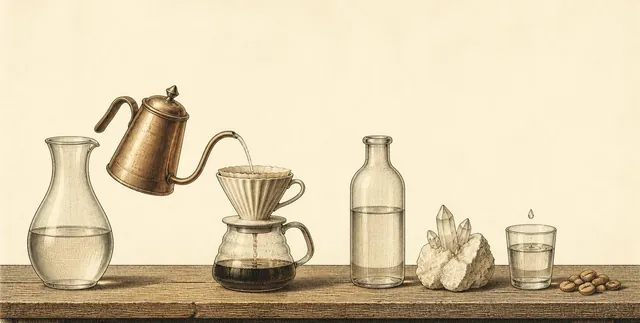
Water is not a neutral solvent. Calcium and magnesium help pull flavour out of ground coffee; bicarbonate neutralises the acids that make a washed Kenyan taste of blackcurrant. The same bag can taste bright in Glasgow and dull in Cambridge. Your water company's postcode lookup and one side-by-side test tell you most of what matters.
What do hardness and alkalinity mean for coffee?
Hardness is mostly calcium and magnesium. In the UK it is usually given in milligrams per litre as calcium carbonate (mg/l CaCO₃). Some hardness helps extraction; water with almost none tastes thin and hollow.
Alkalinity (bicarbonate, the "temporary" or carbonate part of hardness) buffers acid. It is also what turns into limescale in the kettle. Marco Wellinger of the Zurich University of Applied Sciences, writing for the Specialty Coffee Association, argues that alkalinity, not pH, decides how much acidity survives into the cup. For coffee it is the more important of the two numbers.
The Drinking Water Inspectorate (DWI), which regulates tap water in England and Wales, uses five bands. It also notes that the drinking water regulations set no standard for hardness: hard water is safe to drink.
| Band | mg/l as CaCO₃ | What it tends to mean for coffee |
|---|---|---|
| Soft | up to 100 | acidity comes through; very soft water can taste thin |
| Slightly hard | 100 to 150 | usually fine for filter and espresso |
| Moderately hard | 150 to 200 | light roasts start to lose brightness |
| Hard | 200 to 300 | muted acidity; scale in kettles and machines |
| Very hard | more than 300 | filtering pays off for taste and for the machine |
Where is UK water hard or soft?
Hardness follows geology. Rain that soaks through chalk and limestone picks up calcium; rain that runs off hard rock and peat into upland reservoirs stays soft.
- London and the South East: Thames Water says most water in the South East of England is hard, and all the water in its own region is, because it passes through chalky limestone.
- East of England: Anglian Water classes all the water in its region as hard to very hard, from chalk bedrock.
- Scotland: Scottish Water states that most of Scotland's water is soft, because it comes from lochs, rivers and burns and chalk is rare there. It publishes hardness for every supply zone each year.
- North West England: United Utilities says most of its raw water comes from upland reservoirs and is soft or very soft; a few boreholes in the south of the region are harder.
- Wales: Dŵr Cymru Welsh Water notes that water from lowland lakes or groundwater is more likely to be hard, and gives the hardness for your address in its "In your area" lookup.
These are regional patterns, not your tap. The DWI's advice is to ask your water company, because hardness varies locally; every company above has a postcode lookup.
What water does the SCA recommend for brewing?
The Specialty Coffee Association's brewing water standard (published in 2009 by the then SCAA) targets about 150 mg/l total dissolved solids, calcium hardness around 68 mg/l as CaCO₃, alkalinity around 40 mg/l, a pH close to 7 and no chlorine.
Against the DWI bands, that is soft water with little bicarbonate. Much of southern and eastern England is well above it. Treat it as a direction, not a limit; tastes differ. Wellinger also points out that espresso tolerates more alkalinity than filter, because far less water meets the same amount of coffee.
Does water matter more for light or dark roasts?
For light roasts, clearly. A light roast is sold on its acidity: citrus, berries, stone fruit. High alkalinity neutralises part of that acid, so the cup tastes flat or even earthy. A dark roast has less acidity to lose and more roast bitterness, so hard water changes it less, and some people find it rounds off a dark roast. With chocolatey espresso blends in milk, water matters less than grind and dose; with light filter coffees it can matter most.
The chart shows how roasters in Bean Index describe their roast level, and how often they state none.
Why fruity is a flavour and not a fault is explained in fruity is not the same as sour; what makes a roast "light" in the first place is in light roast coffee.
What can you do about hard water?
- Jug filter with ion-exchange resin: most cartridges combine resin, which lowers part of the carbonate hardness, with activated carbon, which removes chlorine taste. In a hard-water area this is the simplest first step. Change cartridges as the maker says; a spent one stops working.
- Activated carbon only (tap or under-sink): removes chlorine and odours, leaves hardness much as it was.
- Machine filters and tank cartridges: mainly protect the boiler. On an espresso machine or bean-to-cup machine, set the water hardness the maker asks for; scale damage is often excluded from warranties.
- Reverse osmosis: removes almost everything, minerals included. It needs remineralising, or the coffee tastes empty.
- Bottled water: UK law sorts it into natural mineral water, spring water and bottled drinking water. Mineral water labels usually list the composition: look for low bicarbonate, moderate calcium and magnesium and little sodium, and leave sparkling water out.
- Mineral recipes: sachets such as Third Wave Water, or home-mixed mineral recipes, are dissolved in distilled water to give the same water every time, wherever you live. Precise, but more effort than most people need.
Avoid distilled or softened water on its own. Distilled water tastes empty, and some machines cannot sense their water level with it. A salt-based household softener swaps calcium for sodium, and United Utilities advises keeping an unsoftened tap for drinking.
How do you test whether water is the problem?
Brew the same coffee twice at the same grind and ratio: once with tap water, once with a soft still bottled water. If the bottled cup is clearly brighter, your tap water is muting it. Change one thing at a time; if water is not the issue, look at grind size next (see what to look for in a grinder for filter coffee).
- Flat, dull, little acidity despite a light roast: often too much alkalinity.
- Thin, sharp, sour: the water may be very soft, or the grind too coarse.
- Swimming-pool smell: chlorine; a carbon filter helps.
Which beans suit which brewer is covered under espresso beans and coffee beans for bean to cup machines.
What we don't know
- Your tap water. Only your water company's data or a test kit can tell you that.
- How well a given filter works. We have not tested filters, bottled waters or mineral sachets, so we name no models and no favourites.
- What your machine tolerates. The manufacturer's water settings come first, not least for the warranty.
Filter roasts in Bean Index
Outpost CoffeeNottingham, UK
BROKEN PROMISE 001 / 72hr Anaerobic Natural / Uganda
Uganda, Mt. Elgon, 1,900 m
Natural (anaerobic), SL28, SL34
Citrus, Tropical & winey, Stone fruit
Omni roast
Price per kg £80.00/kg
£16.00 for 200 g, excl. delivery, checked
77% above median for Natural from Uganda
To roasterOvenbird CoffeeGlasgow, UK
Ethiopia Yirgachefe G1 Chelelektu
Ethiopia, Yirgacheffe, 1,800 m
Natural, Ethiopian Landrace
Floral & tea, Tropical & winey
Omni roast
Price per kg £42.00/kg
£21.00 for 500 g, excl. delivery, checked
Ozone Coffee UKStafford, UK
Bolivia: Arcangel, Dry Fermented Washed
Bolivia, Caranavi, 1,500 m
Washed, Caturra, Catuai
Citrus, Berries, Chocolate
Omni roast
Price per kg £58.86/kg
£12.95 for 220 g, excl. delivery, checked
7% above median for Washed
To roasterPharmacie Coffee RoastersLewes, UK
Carlos Mejia, Honduras
Honduras, La Paz, 1,450 m
Natural, Catuai
Tropical & winey, Nut & caramel
Filter & espresso roast
Price per kg £48.00/kg
£12.00 for 250 g, excl. delivery, checked
15% below median for Natural from Honduras
To roasterPoblado CoffiNantlle, UK
Guatemala - Primavera Family
Guatemala, Huehuetenango, 1,550–1,650 m
Washed, Caturra, Catuai
Chocolate
Omni roast
Price per kg £38.00/kg
£9.50 for 250 g, excl. delivery, checked
28% below median for Washed from Guatemala
To roasterRedemption RoastersLondon, UK
Gerse
Ethiopia, Yirgacheffe, 2,000–2,200 m
Washed, Ethiopian Landrace
Berries, Nut & caramel
Filter roast
Price per kg £67.00/kg
£16.75 for 250 g, excl. delivery, checked
16% above median for Washed from Ethiopia
To roasterFilter and omni roasts in the catalogue · filter coffee beans
Sources & method
- Hardness bands, no regulatory standard, ask your water company: Drinking Water Inspectorate, Water hardness / hard water (undated page, read October 2026).
- Regions: Thames Water, Water hardness; Anglian Water, Hard water and its water quality fact sheet on hard water; Scottish Water, Fact sheet 12 (2020) and water hardness by supply zone (2024 data); United Utilities, Water hardness and fact sheet (2025); Dŵr Cymru Welsh Water, Water hardness. All read October 2026.
- Brewing water target: Specialty Coffee Association of America, brewing water standard (2009); background in the SCA Water Quality Handbook (2018). Alkalinity and espresso: M. Wellinger, Water and coffee acidity, SCA 25 Magazine, issue 9.
- Bottled water categories: The Natural Mineral Water, Spring Water and Bottled Drinking Water (England) Regulations 2007, legislation.gov.uk.
- Filter types and taste: common barista knowledge as described by roasters and the SCA. We made no tests or measurements of our own.
- Roast level according to the roaster: from the roasters' shops, see the methodology. Bean Index figures: available coffees, n = 1,510, checked 19 Oct 2026.
This guide is also available in German: Wasser für Kaffee: Härte, Filter und was wirklich zählt (Bohnenatlas)