Coffee grinder for filter coffee: what matters
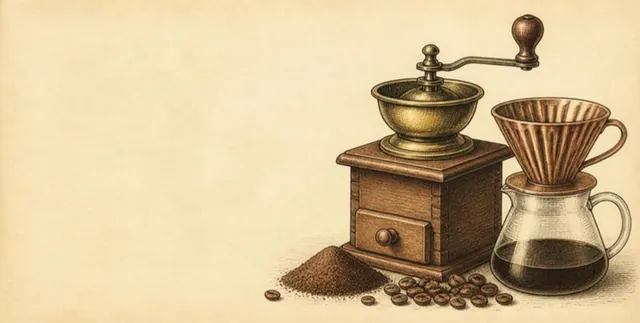
When you brew, water dissolves flavour from the surface of the grounds. Fine particles give up a lot, fast; coarse ones give up little, slowly. If a grinder grinds unevenly, the same cup holds over-extracted particles next to under-extracted ones: it tastes bitter and sour at once, and no grind setting fixes that. That is why, for filter coffee, a better grinder often changes more than a more expensive coffee.
Why does consistency matter so much?
No grinder makes every particle the same size. There are always some fines – dust – and some boulders that are too coarse. The more of both, the harder the coffee is to dial in. Fines also clog the paper filter: water drains more slowly, the brew runs longer and the cup turns bitter and dry. If your pour over drains fast one day and slowly the next with the same recipe, the grinder is often the cause.
How to spot an even grinder without lab equipment: the shaft doesn't wobble when you wiggle the burr. In hand grinders it is usually supported by a bearing at the top and the bottom. Under a bright lamp the grounds look uniform, with little dust clinging to the walls and no half beans.
Burr or blade: why blade grinders struggle with filter
A blade grinder doesn't grind; it chops. A blade spins fast and smashes the beans for as long as you hold the button. There is no grind setting, only a running time. The result ranges from dust to chunks. For a cafetière or cold brew that may just about pass; for pour over it makes cups hard to repeat. If you don't have a burr grinder, pre-ground coffee from the roaster is often the better option: many UK roasters grind to order for pour over, filter machine or cafetière.
Conical or flat burrs?
Both designs can grind very evenly. Build quality and how well the shaft is supported matter more than the shape.
- Conical burrs: a cone-shaped inner burr turns inside an outer ring. It runs at low speed, is quieter and fits small bodies. Almost all hand grinders and many entry-level electric grinders use it.
- Flat burrs: two flat, toothed discs face each other, one of them turning. They need more power, so flat burrs sit almost only in electric grinders. Many grinders designed specifically for filter use large flat burrs.
You'll often read that flat burrs give a clearer cup and conical burrs a fuller one. It's a common description, not a fixed rule. For hand grinders, steel burrs are usual and proven for filter. Ceramic burrs often sit in very cheap grinders whose shaft wobbles; then the problem is the bearing rather than the material.
Hand grinder or electric?
For the same grind quality, a hand grinder costs considerably less than an electric one. It's quiet, needs no power and fits in a bag. In return you turn the handle for something like half a minute to a minute per cup of filter, depending on the grinder. For one or two cups a day that's fine for many people; for a full jug it isn't.
An electric grinder is worth it if you brew several cups a day or want to spare your wrists. With cheap electric grinders, check that they really have burrs and not a blade. Some grinders are good for filter only, others for espresso only; few do both equally well. If you also want to make espresso, see the grinder section in espresso machine or bean to cup.
Settings, adjustment and retention: what really counts?
Settings. A big number of steps on the box says little. What matters is how many steps fall in the filter range and how large the jump between two steps is. Filter needs much coarser steps than espresso. Stepless grinders allow any point in between; you then need another way to remember your setting, such as a mark.
Adjustment. If you switch often between pour over and a cafetière, an external adjustment with a scale helps. On some hand grinders you have to take the burrs apart to change it. Note your setting as a number of clicks from zero, the point where the burrs just touch.
Retention. This is the coffee that stays inside the grinder after grinding. It ends up in your next cup – after a change of beans, that means some of the old ones. Hand grinders usually retain little, electric ones more. If you weigh beans for each cup and grind fresh, look for low retention. Running a few beans through first helps when you switch. A drop of water on the beans before grinding reduces static in many grinders, so less coffee clings.
Why does the grinder matter most with light filter roasts?
Filter roasts are usually light; what “light” actually means is in light roast coffee. Light beans are denser and harder to extract; their fruit and acidity only come through when the grounds are even. Ground unevenly, they quickly taste sharp and bitter at the same time. Among filter roasts on Bean Index whose notes we can place, 58% read fruity and bright (n = 118, checked 19 Oct 2026; the notes are the roasters' words, read by AI). Why fruity doesn't have to mean sour is explained in fruity is not the same as sour.
Which grind size for which brew method?
Every grinder's numbers are different, so comparisons with familiar textures help more than settings. The table is a starting point. If the cup tastes thin and sour, grind finer; if it turns bitter and dry, grind coarser. Change one thing at a time.
| Brew method | Grind | Feels like |
|---|---|---|
| Espresso machine | very fine | flour to icing sugar |
| Moka pot | fine | a little coarser than espresso |
| AeroPress | fine to medium | depends on the recipe, usually fine sand |
| Pour over (V60-style, flat-bottom) | medium-fine | fine sand, table salt |
| Filter machine | medium | a little coarser than for pour over |
| Chemex-style carafe | medium to coarse | coarse sand |
| Cafetière | coarse | coarse sea salt |
| Cold brew | very coarse | cracked black pepper |
Grind just before brewing. Ground coffee loses aroma much faster than whole beans. If you mostly brew in a cafetière, see cafetière coffee beans.
What does a usable filter grinder cost?
We don't track equipment prices, so no amounts here – only relations that hold across the market:
- Blade grinders are the cheapest, but no shortcut for filter.
- Hand grinders with steel conical burrs and a shaft supported at both ends are the least expensive way to an even filter grind. Hand grinders that also grind fine and repeatably for espresso usually cost a good deal more.
- Electric grinders that grind evenly enough for filter generally cost more than a comparable hand grinder; large flat-burr grinders designed for filter sit at the upper end.
What else you need, and in which order it's worth buying, is in pour over at home: what you actually need.
What we don't know
- How individual grinders perform. We haven't tested any grinder or measured particle sizes, so we name no models and pick no winners.
- Prices. We don't track equipment prices.
- How your coffee tastes. Bean, water, recipe and taste all play a part. The grinder is an important one, not the only one.
Filter coffees on Bean Index
Outpost CoffeeNottingham, UK
BROKEN PROMISE 001 / 72hr Anaerobic Natural / Uganda
Uganda, Mt. Elgon, 1,900 m
Natural (anaerobic), SL28, SL34
Citrus, Tropical & winey, Stone fruit
Omni roast
Price per kg £80.00/kg
£16.00 for 200 g, excl. delivery, checked
77% above median for Natural from Uganda
To roasterOvenbird CoffeeGlasgow, UK
Ethiopia Yirgachefe G1 Chelelektu
Ethiopia, Yirgacheffe, 1,800 m
Natural, Ethiopian Landrace
Floral & tea, Tropical & winey
Omni roast
Price per kg £42.00/kg
£21.00 for 500 g, excl. delivery, checked
Ozone Coffee UKStafford, UK
Bolivia: Arcangel, Dry Fermented Washed
Bolivia, Caranavi, 1,500 m
Washed, Caturra, Catuai
Citrus, Berries, Chocolate
Omni roast
Price per kg £58.86/kg
£12.95 for 220 g, excl. delivery, checked
7% above median for Washed
To roasterPharmacie Coffee RoastersLewes, UK
Carlos Mejia, Honduras
Honduras, La Paz, 1,450 m
Natural, Catuai
Tropical & winey, Nut & caramel
Filter & espresso roast
Price per kg £48.00/kg
£12.00 for 250 g, excl. delivery, checked
15% below median for Natural from Honduras
To roasterPoblado CoffiNantlle, UK
Guatemala - Primavera Family
Guatemala, Huehuetenango, 1,550–1,650 m
Washed, Caturra, Catuai
Chocolate
Omni roast
Price per kg £38.00/kg
£9.50 for 250 g, excl. delivery, checked
28% below median for Washed from Guatemala
To roasterRedemption RoastersLondon, UK
Gerse
Ethiopia, Yirgacheffe, 2,000–2,200 m
Washed, Ethiopian Landrace
Berries, Nut & caramel
Filter roast
Price per kg £67.00/kg
£16.75 for 250 g, excl. delivery, checked
16% above median for Washed from Ethiopia
To roasterFilter and omni roasts in the catalogue · Filter coffee beans
Sources & method
- Extraction and grind uniformity: Ted R. Lingle, The Coffee Brewing Handbook, Specialty Coffee Association of America, 2nd edition 2011. Burr types, grind sizes and retention: common barista practice as roasters describe it. We have not tested or measured anything ourselves.
- Flavour axis: read by AI from the roasters' notes, not a measurement; the formula is in our methodology.
- Figures from Bean Index: coffees on sale, n = 1,510, checked 19 Oct 2026.
This guide is also available in German: Kaffeemühle für Filterkaffee: worauf du achten solltest (Bohnenatlas)