Pour over at home: what you actually need
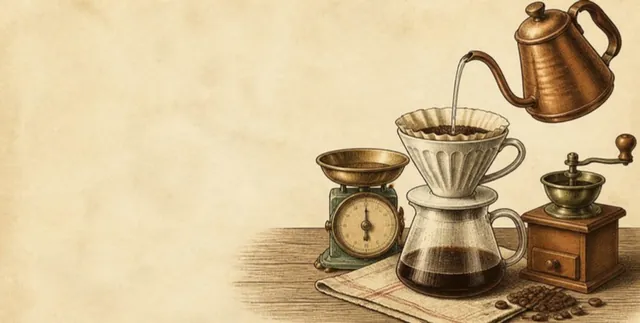
Pour over means pouring hot water by hand over ground coffee in a filter; the coffee drips into a cup or jug. That's all the technology there is. Much of what is sold as a “starter kit” is handy but optional at first. Here is what counts, and what you can add later.
Which cone: V60, flat-bottom or Chemex?
The designs differ mainly in how fast water runs through and how much the result depends on your pouring. We describe types, not products; any well-made cone of a type behaves much like another.
| Type | Shape | What it means for you |
|---|---|---|
| Conical, one large hole (V60-style) | steep cone, ribs inside | flow depends strongly on your pour: lots of control, little forgiveness |
| Flat-bottom (Kalita Wave-style) | flat base, small holes, fluted paper | even flow, forgives uneven pouring |
| Wedge cone | narrow flat base, one or a few small holes | slower flow, simple to use, papers in most supermarkets |
| Chemex-style carafe | glass jug with a built-in funnel, thick paper | very clean cup, suited to several cups at once, needs a coarser grind and its own filters |
To start, a flat-bottom or wedge cone is the easiest. A V60-style cone is worth it if you like to experiment. On materials: plastic is cheap, unbreakable and holds heat well; ceramic and glass should be preheated with hot water.
Which paper filters?
The filter has to match the cone: conical papers for a V60-style cone, fluted papers for a flat-bottom one, the right size of wedge papers, and dedicated filters for a Chemex. White (bleached) papers taste less of paper than brown ones. Rinse every filter with hot water before adding coffee: it removes papery taste and preheats everything. Metal filters let oils and fine particles through, so the cup is fuller and cloudier, never as clean as with paper.
Do I really need a scale?
Yes, if you want to know what went wrong. Scoops vary a lot with bean and grind; a scale doesn't. A kitchen scale that reads to the gram is enough to begin with. A coffee scale with tenths of a gram and a built-in timer is more convenient because you see water and time together. Of all the pieces here, it is among the cheapest and most useful.
Gooseneck kettle: essential or nice to have?
A gooseneck spout gives a thin, steady stream, so you pour more slowly and evenly – which helps with a V60-style cone. To start, an ordinary kettle will do: let it rest briefly after boiling and pour in small amounts. Water just off the boil is the usual starting point; the Specialty Coffee Association's brewing standard gives 90–96 °C at the coffee, and light roasts generally like the hotter end. Temperature-controlled kettles are more expensive and only worth it once the rest is in place.
Grinder or pre-ground?
Freshly ground tastes clearly better, because ground coffee loses aroma quickly. Still, you don't have to start with a grinder: many UK roasters will grind for pour over or filter if you ask at checkout. If you do buy a grinder, get one with burrs, not a blade. What to look for is in grinder for filter coffee: what matters.
A starting recipe: how much coffee for pour over?
Many roasters give a similar starting recipe. It is a starting point, not a rule:
- Grind 15 g of coffee medium-fine, roughly like fine sand.
- Put in the paper filter, rinse it with hot water, pour the rinse water away.
- Add the coffee and zero the scale.
- Pour about twice as much water as coffee and wait half a minute while the grounds swell (the “bloom”).
- Top up to 250 g of water in two or three pours, in small circles in the middle, not straight onto the paper.
- Let it drain. For one cup the whole brew usually takes around three minutes.
If the cup tastes thin and sour or drains very fast, grind finer. If it tastes bitter and dry or drains very slowly, grind coarser. Change one thing at a time. For a stronger cup, use a little more coffee with the same water. For reference, the SCA's brewing standard works with roughly 55 g of coffee per litre; the recipe above is slightly stronger.
What water?
A cup of filter coffee is almost all water, so you taste it. Very hard water, common in London and much of the South and East of England, often makes coffee flat and scales up your kettle; very soft water can make it taste sharp. Your water company publishes the hardness for your postcode. If yours is very hard, try filtered water or a mild still bottled water and compare two cups side by side. More in water for coffee.
In what order is it worth buying?
Ordered by how much each step changes the cup, relative to what it costs:
- Fresh beans roasted for filter, ground by the roaster if need be.
- Cone and paper filters. Inexpensive, and you can't start without them.
- Scale. Costs little and makes every cup repeatable.
- Burr grinder. The biggest outlay and the biggest step up in taste.
- Gooseneck kettle, later with temperature control. Pleasant, but only once the rest is settled.
Jugs, stands and thermometers can wait until you actually miss them.
Which beans for pour over and V60?
Coffees the roaster roasts for filter, or as an omni roast for both filter and espresso, suit pour over. On Bean Index that's 162 filter and 368 omni roasts (checked 19 Oct 2026). Filter roasts are usually light and often taste of fruit or flowers; what “light” means is explained in light roast coffee. With 15 g per cup, most coffees cost between £0.54 and £1.10 a cup; see how much speciality coffee costs per kg.
If you'd rather start with immersion than pouring, an AeroPress or a cafetière is just as easy: coffee for AeroPress, coffee for a cafetière.
| Group | Median | Filter (15 g) | Espresso (18 g) |
|---|---|---|---|
| All | £51/kg | £0.76 | £0.91 |
| Washed | £54/kg | £0.81 | £0.97 |
| Natural | £52/kg | £0.78 | £0.94 |
| Anaerobic | £68/kg | £1.03 | £1.23 |
| Gesha (Geisha) | £100/kg | £1.50 | £1.80 |
| Blends | £44/kg | £0.66 | £0.79 |
What we don't know
- Which cone, scale or kettle suits you. We haven't tested equipment and pick no winners. The types above are descriptions, not recommendations.
- Equipment prices. We don't track them, so we give an order of purchase rather than amounts.
- Your water and your taste. The recipe is a start; the right cup comes from trying.
Coffees for pour over on Bean Index
Outpost CoffeeNottingham, UK
BROKEN PROMISE 001 / 72hr Anaerobic Natural / Uganda
Uganda, Mt. Elgon, 1,900 m
Natural (anaerobic), SL28, SL34
Citrus, Tropical & winey, Stone fruit
Omni roast
Price per kg £80.00/kg
£16.00 for 200 g, excl. delivery, checked
77% above median for Natural from Uganda
To roasterOvenbird CoffeeGlasgow, UK
Ethiopia Yirgachefe G1 Chelelektu
Ethiopia, Yirgacheffe, 1,800 m
Natural, Ethiopian Landrace
Floral & tea, Tropical & winey
Omni roast
Price per kg £42.00/kg
£21.00 for 500 g, excl. delivery, checked
Ozone Coffee UKStafford, UK
Bolivia: Arcangel, Dry Fermented Washed
Bolivia, Caranavi, 1,500 m
Washed, Caturra, Catuai
Citrus, Berries, Chocolate
Omni roast
Price per kg £58.86/kg
£12.95 for 220 g, excl. delivery, checked
7% above median for Washed
To roasterPharmacie Coffee RoastersLewes, UK
Carlos Mejia, Honduras
Honduras, La Paz, 1,450 m
Natural, Catuai
Tropical & winey, Nut & caramel
Filter & espresso roast
Price per kg £48.00/kg
£12.00 for 250 g, excl. delivery, checked
15% below median for Natural from Honduras
To roasterPoblado CoffiNantlle, UK
Guatemala - Primavera Family
Guatemala, Huehuetenango, 1,550–1,650 m
Washed, Caturra, Catuai
Chocolate
Omni roast
Price per kg £38.00/kg
£9.50 for 250 g, excl. delivery, checked
28% below median for Washed from Guatemala
To roasterRedemption RoastersLondon, UK
Gerse
Ethiopia, Yirgacheffe, 2,000–2,200 m
Washed, Ethiopian Landrace
Berries, Nut & caramel
Filter roast
Price per kg £67.00/kg
£16.75 for 250 g, excl. delivery, checked
16% above median for Washed from Ethiopia
To roasterFilter and omni roasts in the catalogue · Coffee for V60 and pour over
Sources & method
- Brew ratio and water temperature: Specialty Coffee Association, Golden Cup standard for brewed coffee (sca.coffee, coffee standards). Designs, recipe steps and grind: common barista practice and the starting recipes UK roasters publish. We have not tested anything ourselves.
- Water hardness: water companies' postcode look-ups (for London, Thames Water's water hardness pages), checked October 2026.
- Price per cup: price per kg × 15 g ÷ 1000, price per kg from the standard bag, n = 1,370. Details are in our methodology.
- Roast use according to the roaster: roasters' information, n = 1,510 coffees on sale, checked 19 Oct 2026.
This guide is also available in German: Handfilter für Einsteiger: was du für Filterkaffee wirklich brauchst (Bohnenatlas)