Light roast coffee: when is light really light?
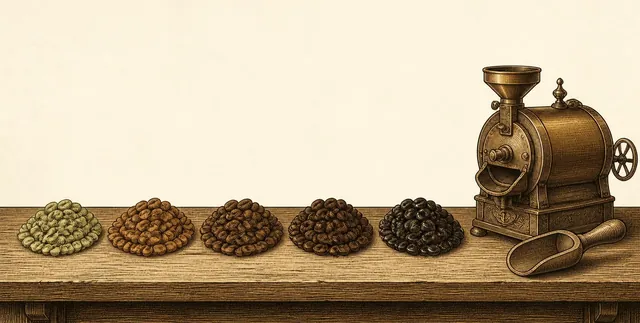
Ask on a coffee forum for "light roasts" and you get three answers and five questions back. That is not the people, it is the word: what a Nordic-style filter roaster calls medium would be almost tea in an Italian espresso bar, and one roaster's light espresso is another's ordinary omni roast. Here is what is behind the word, what our figures show and how to find what you are after anyway.
What does light roast actually mean?
Beans change in stages in the roaster: they dry, they brown, and then they audibly crack open, the "first crack". A light roast means the roaster takes the beans out not long after first crack. More acidity remains, and more of what comes from origin and process: fruit, florals, tea. The longer the roast goes on, the more roast flavours take over, first chocolate and caramel, later bitterness.
Colour can be measured with devices that read the light reflected by ground coffee; the best known is the Agtron scale, which the Specialty Coffee Association also uses for its roast colour classification. A few roasters publish such values; most don't. Even then colour is not everything: two beans of the same colour can taste quite different depending on the roast profile.
Why does light mean something different at every roaster?
Because each roaster measures against its own range. A roaster that does mostly filter may call its darkest coffee medium. A roaster that mostly roasts espresso for flat whites and lattes may call something light that a filter roaster would sell as medium. There is no binding scale, legal or otherwise.
In practice, a roast level is most useful within one roaster: of two coffees from the same roaster, "light" is lighter than "medium". Between two roasters it is a direction rather than a measure.
How many roasters state a roast level?
Surprisingly few. For 75% of the coffees on sale in Bean Index, no roast level appears anywhere, neither in the shop's filters nor in the description. Overall, 41 of 111 roasters state it for at least one coffee. Where a level is stated, 106 coffees are light or medium-light according to the roaster.
Filter and espresso differ clearly: among roasts for filter only with a stated level, 47% are light or medium-light (n = 45); among roasts for espresso only, 6% (n = 51).
How can you tell a light roast without a label?
- Brewing according to the roaster. Filter roasts are nearly always lighter than the same roaster's espresso roasts; omni roasts usually sit in between.
- The tasting notes. Berries, citrus, stone fruit, florals and tea point towards light; chocolate, nut and caramel towards medium and darker. That is a tendency, not proof: a natural can taste of berries at a medium roast.
- The beans. Light beans are cinnamon to hazelnut brown and matt. If they look oily, the roast is probably dark, or the bag is old.
- The roaster. Many speciality roasters roast light overall, classic espresso roasters darker. The rest of the range tells you a lot.
In the catalogue you can filter by roast level according to the roaster: light and medium-light coffees. Coffees without a stated level are not in that list, though they may still be light. How fruity a coffee reads from its notes is shown by the flavour axis on every coffee page; why fruity is not the same thing as sour is in fruity is not sour.
What does a light roast need from your grinder and brewer?
Light beans are denser and harder to extract. Brewed like a darker roast, they easily come out thin and sour rather than fruity, and that is not the bean's fault. As a rule of thumb they want a finer grind, water just off the boil and sometimes a little more time.
- Grinder. You will usually grind finer than for a darker coffee, and an even grind matters more, because uneven particles show quickly in a light cup. A grinder with small steps makes dialling in easier; see which grinder for filter coffee.
- Filter and cafetière. Light roasts show their notes best in pour-over and filter. In a cafetière, a slightly finer grind or a longer steep helps.
- Espresso. It works, but it is less forgiving: finer grind, higher temperature and often a longer ratio than classic espresso. Under-extracted, it tastes sharp.
- Bean to cup. Light roasts are tricky in many bean to cup machines, because grind, temperature and brew time often can't be adjusted far enough. More in coffee beans for bean to cup machines.
- Water. Because light roasts live on their acidity, water hardness shows more; see water for coffee.
Are light roasts more expensive?
In Bean Index, coffees with a light or medium-light roast level have a median price of £51/kg, the others with a stated level £43/kg (price per kg of the standard bag, checked 19 Oct 2026). The likely reason is less the roast itself than the selection: single origins, rare varieties and elaborate processes are the coffees most often roasted light. Why coffee costs what it does per kg is in how much speciality coffee costs per kg.
What we don't know
- How light a coffee really is. We use only the roast level the roaster states. We don't measure colour and don't estimate a roast level from origin or notes.
- How the scales compare. "Light" at two roasters can differ a lot; the label is comparable mainly within one roaster.
- How it tastes to you. Roast, bean, water and recipe work together. You learn most by tasting two coffees side by side.
Light roasts in Bean Index
Ovenbird CoffeeGlasgow, UK
Ethiopia Yirgachefe G1 Chelelektu
Ethiopia, Yirgacheffe, 1,800 m
Natural, Ethiopian Landrace
Floral & tea, Tropical & winey
Omni roast
Price per kg £42.00/kg
£21.00 for 500 g, excl. delivery, checked
Artisan RoastEdinburgh, UK
La Guaca
Colombia, Huila, 1,745 m
Natural, Bourbon Ají
Citrus, Berries, Dried fruit & spice
Filter roast
Price per kg £56.00/kg
£14.00 for 250 g, excl. delivery, checked
20% below median for Natural from Colombia
To roasterCast Iron Coffee RoastersChichester, UK
Andy Llanos, Geisha
Peru, Cajamarca, 1,820 m
Washed, Gesha
Floral & tea, Citrus, Tropical & winey
Omni roast
Price per kg £147.06/kg
£50.00 for 340 g, excl. delivery, checked
47% above median for Gesha (Geisha)
To roasterHej CoffeeLondon, UK
Capulinero
Costa Rica, Tarrazú, 1,500–1,800 m
Experimental (anaerobic), Caturra, Catuai
Citrus, Tropical & winey, Stone fruit
Omni roast
Price per kg £50.00/kg
£12.50 for 250 g, excl. delivery, checked
8% below median for Costa Rica
To roasterHorsham Coffee RoasterBurgess Hill, UK
Coffee Bird Decaf
Guatemala, Acatenango, 1,500 m
Washed, Bourbon, Caturra
Berries, Chocolate, Nut & caramel
Filter roast
Price per kg £51.00/kg
£12.75 for 250 g, excl. delivery, checked
around the median for Decaf
To roasterHej CoffeeLondon, UK
HEJ FC (Peru, El Oso)
Peru, Cajamarca, 1,350–1,890 m
Washed, Bourbon, Catimor
Citrus, Berries, Chocolate
Omni roast
Price per kg £42.00/kg
£10.50 for 250 g, excl. delivery, checked
27% below median for Washed from Peru
To roasterSources & method
- Roast level: only what the roaster states, from its shop's filter, a labelled field or the description (then marked as read by AI). Rules: methodology.
- Roasting, first crack and colour measurement: general roasting knowledge and the roast colour classification of the Specialty Coffee Association (SCA, sca.coffee). We have not roasted or measured anything ourselves.
- Prices: price per kg of the standard bag (200 to 350 g), medians only for large enough groups.
- Figures: coffees on sale in Bean Index, n = 1,510, checked 19 Oct 2026.
This guide is also available in German: Helle Röstung: Wann ist hell wirklich hell? (Bohnenatlas)