Espresso machine or bean to cup: what changes for the beans
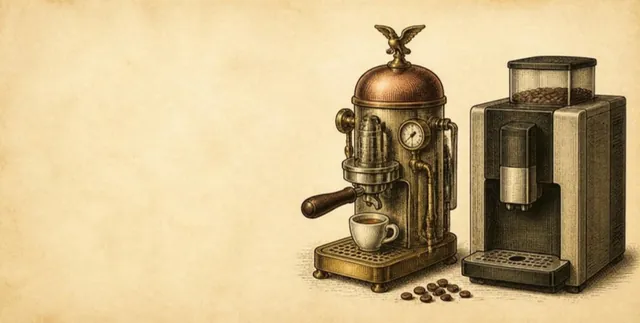
Both machines force hot water under pressure through finely ground coffee. The difference is who does the work. In a bean to cup machine a mechanism grinds, doses, tamps and brews. On a manual (traditional, or “semi-automatic”) espresso machine you do it yourself: grind, fill the portafilter, tamp, lock in, start the shot. Almost every difference in effort, cost and taste – and in which beans work – follows from that.
What changes, at a glance?
| Question | Bean to cup machine | Espresso machine |
|---|---|---|
| Grind control | built-in grinder, a few fixed steps | separate grinder (or built in), fine steps |
| Dose and shot time | set by the machine, a few strength levels | you weigh and time it |
| Roasts that work | espresso and omni roasts, not too oily | espresso and omni roasts; lighter roasts with a capable grinder |
| Changing beans | old beans linger in the grinder for a few cups | a few test shots per new bag |
| Milk | automatic, foam firmer and coarser | steam wand, finer microfoam with practice |
| Daily cleaning | grounds bin, drip tray, milk system | knock out, rinse group, purge steam wand |
What changes for the beans?
Bean to cup machine: espresso or omni roasts with chocolatey, nutty or balanced notes, and no very oily, flavoured or caramelised beans – manufacturers warn these can clog or damage the grinder. Light filter roasts often come out thin and sour because the grinder can't go fine enough and the shot is short. Everything about this, with notes on Ninja, Sage, De'Longhi, Philips, Jura, Melitta, Smeg and Miele machines, is in which coffee beans for a bean to cup machine; our selection is under beans for bean to cup.
Espresso machine: espresso and omni roasts are the usual start. With a grinder that goes fine enough in small steps, lighter roasts work too, but they forgive less and use more beans while you dial in. → Espresso beans from UK roasters
“Espresso beans” are not a different kind of coffee. They are beans roasted with espresso in mind, usually a touch longer or darker so they dissolve well in a short brew. The roaster decides, and there is no standard. The difference shows in the roasters' own notes: of espresso roasts on Bean Index whose notes we can place, 40% read chocolatey and nutty, against 15% of filter roasts (checked 19 Oct 2026).
Whole beans or pre-ground for an espresso machine?
Whole beans and your own grinder. Espresso reacts to tiny changes in grind size, and each bag needs its own setting. Pre-ground coffee can't be adjusted and goes stale quickly. Many entry-level machines come with dual-wall (pressurised) baskets that produce crema even from pre-ground coffee: fine to start with, limiting in the long run. A bean to cup machine always grinds fresh, which is one of its real advantages.
How much effort is a cup?
With a bean to cup machine a cappuccino takes as long as the machine needs. With an espresso machine, allow a few minutes per drink: grind, weigh, distribute, tamp, pull the shot, steam the milk, knock out the puck. Making several drinks for a household in the morning, you'll notice. If you enjoy the ritual, it doesn't feel like effort.
How steep is the learning curve?
On a bean to cup machine you set grind, strength and temperature once and change little afterwards. There's not much to learn, and not much more to get out of it. On an espresso machine the result depends on grind, dose, tamping and shot time. Expect a few shots with every new bag before it's right. The rule of thumb: if the shot runs fast and tastes sour, grind finer; if it runs slowly and tastes bitter, grind coarser.
Why does the grinder matter so much?
For an espresso machine the grinder matters as much as the machine itself. Many grinders made for filter coffee don't go fine enough for espresso, or not in small enough steps. Machines with a built-in grinder, such as some Sage models, avoid a second purchase; a separate grinder gives more range. Why grinders make such a difference is explained in what matters in a coffee grinder.
What does a cup cost?
Ongoing, the main cost is beans. For a double espresso with 18 g, a cup at the median price per kg on Bean Index costs about £0.91 (checked 19 Oct 2026). Bean to cup machines often use less coffee per drink. Add descaler, cleaning tablets and, depending on the machine, water filters; for an espresso machine, cleaning powder and the occasional new group gasket. What a kilo of espresso beans costs at UK roasters, and where good value starts, is in affordable espresso beans.
| Group | Median | Filter (15 g) | Espresso (18 g) |
|---|---|---|---|
| All | £51/kg | £0.76 | £0.91 |
| Washed | £54/kg | £0.81 | £0.97 |
| Natural | £52/kg | £0.78 | £0.94 |
| Anaerobic | £68/kg | £1.03 | £1.23 |
| Gesha (Geisha) | £100/kg | £1.50 | £1.80 |
| Blends | £44/kg | £0.66 | £0.79 |
Flat whites and lattes: what can each do?
Bean to cup machines with an automatic milk system froth at the press of a button. The foam is usually firmer and coarser; for a cappuccino many people find that fine. On an espresso machine you steam with the wand yourself. It takes practice, but it gives the fine, glossy microfoam a flat white or latte art needs. On a single-boiler machine you wait briefly after the shot until steam is ready; heat-exchanger and dual-boiler machines do both at once. For milk drinks, roasts with chocolatey or caramel notes are the usual pick on either machine.
How much cleaning, and what about hard water?
Bean to cup machine: empty the grounds bin and drip tray regularly and rinse the milk system after every use, or milk residue builds up. Add the cleaning and descaling programmes as the manual says. If the brew unit is removable, rinse it regularly.
Espresso machine: knock out and rinse after every shot, wipe and purge the steam wand straight away, and backflush machines with a three-way valve with cleaning powder.
For both, how often you descale depends on your water and the machine. London and much of the South and East of England have hard water; some manufacturers recommend filtered water rather than frequent descaling. Your water company publishes the hardness for your postcode. More in water for coffee.
Which suits you?
- Bean to cup machine if you're short of time, several people in the house want different drinks, and you mostly drink milk drinks.
- Espresso machine if you enjoy the making, want to try different beans, including lighter roasts, and a few minutes per cup is fine.
- Neither if you mostly drink black coffee. A pour-over cone costs a fraction and shows light roasts most clearly: pour over at home: what you actually need. A cafetière, AeroPress or moka pot are other inexpensive routes, covered briefly at the end of the bean to cup guide.
What we don't know
- How individual machines and grinders perform. We haven't tested any, so we name machines only as context and pick no winners.
- Current machine prices. We don't track them.
- How a coffee tastes in your machine. Our figures come from roasters' information, not from tastings.
Espresso and omni roasts on Bean Index
Origin CoffeePorthleven, UK
Arsosala
Ethiopia, Uraga, 1,800–1,900 m
Washed, Ethiopian Landrace
Floral & tea, Citrus, Berries
Espresso roast
Price per kg £58.80/kg
£14.70 for 250 g, excl. delivery, checked
around the median for Washed from Ethiopia
To roasterOutpost CoffeeNottingham, UK
BROKEN PROMISE 001 / 72hr Anaerobic Natural / Uganda
Uganda, Mt. Elgon, 1,900 m
Natural (anaerobic), SL28, SL34
Citrus, Tropical & winey, Stone fruit
Omni roast
Price per kg £80.00/kg
£16.00 for 200 g, excl. delivery, checked
77% above median for Natural from Uganda
To roasterOvenbird CoffeeGlasgow, UK
Ethiopia Yirgachefe G1 Chelelektu
Ethiopia, Yirgacheffe, 1,800 m
Natural, Ethiopian Landrace
Floral & tea, Tropical & winey
Omni roast
Price per kg £42.00/kg
£21.00 for 500 g, excl. delivery, checked
Ozone Coffee UKStafford, UK
Bolivia: Arcangel, Dry Fermented Washed
Bolivia, Caranavi, 1,500 m
Washed, Caturra, Catuai
Citrus, Berries, Chocolate
Omni roast
Price per kg £58.86/kg
£12.95 for 220 g, excl. delivery, checked
7% above median for Washed
To roasterPharmacie Coffee RoastersLewes, UK
Carlos Mejia, Honduras
Honduras, La Paz, 1,450 m
Natural, Catuai
Tropical & winey, Nut & caramel
Filter & espresso roast
Price per kg £48.00/kg
£12.00 for 250 g, excl. delivery, checked
15% below median for Natural from Honduras
To roasterPoblado CoffiNantlle, UK
Guatemala - Primavera Family
Guatemala, Huehuetenango, 1,550–1,650 m
Washed, Caturra, Catuai
Chocolate
Omni roast
Price per kg £38.00/kg
£9.50 for 250 g, excl. delivery, checked
28% below median for Washed from Guatemala
To roasterSources & method
- How the machines work, cleaning and milk: widely published barista practice and manufacturers' manuals (see the sources of the bean to cup guide linked above). We have not tested anything ourselves.
- Water hardness: water companies' postcode look-ups (for London, Thames Water's water hardness pages), checked October 2026.
- Roast use according to the roaster and bean to cup rule version 1: roasters' information; the rule is described in our methodology. n = 1,510 coffees on sale, checked 19 Oct 2026.
- Flavour axis: read by AI from the roasters' notes, not a measurement.
- Price per cup: price per kg × 18 g ÷ 1000, price per kg from the standard bag, n = 1,370.
This guide is also available in German: Siebträger oder Vollautomat? Aufwand, Kosten und Bohnen im Vergleich (Bohnenatlas)