Kenyan coffee: SL28, AA grades and blackcurrant
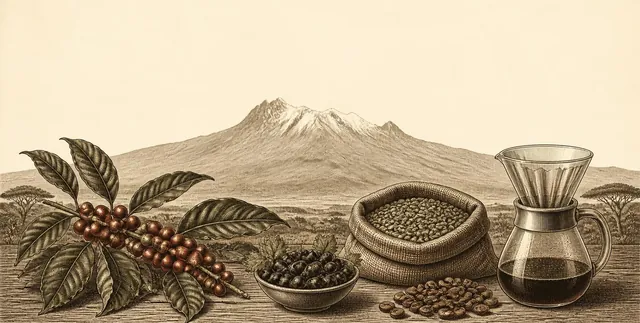
The first well-made Kenyan coffee you brew as a pour-over can come as a surprise: it tastes more like blackcurrant juice than the coffee most people grew up with. That mix of dark fruit and lively acidity has made Kenya a favourite origin of many speciality roasters, and one of the dearer ones.
Where is coffee grown in Kenya?
Mostly in the highlands around Mount Kenya and on the slopes of the Aberdares, on volcanic soils. Well-known regions are Nyeri, Kirinyaga, Murang'a, Kiambu, Embu and Meru. On Bean Index, the regions roasters name most often are Kirinyaga, Nyeri and Kiambu. Where roasters give an altitude, the median is 1,800 m. To browse one region, see Nyeri or Kirinyaga.
Most Kenyan coffee is grown by smallholders. They deliver their cherries to cooperative washing stations, which in Kenya are called "factories". That is why many bags carry the name of a factory, such as Gatomboya or Kangocho, rather than a farm.
SL28, SL34, Ruiru 11 and Batian: which varieties grow there?
SL28 and SL34 were selected in the 1930s by Scott Laboratories in Nairobi, hence the "SL". They are widely credited with the typical Kenyan profile, but they are vulnerable to disease. Ruiru 11 and Batian are later Kenyan breeds with better resistance to coffee leaf rust and coffee berry disease. All four often grow on the same smallholdings and end up mixed in the same lot.
Where roasters name the variety (for 56 Kenyan coffees on Bean Index), the most frequent are SL28 (84%), Ruiru 11 (71%), Batian (68%) and SL34 (64%). Because one coffee can list several varieties, the shares add up to more than a hundred.
What do AA, AB and peaberry mean?
Kenya grades its coffee by bean size. AA are the largest beans, AB slightly smaller ones, and PB stands for peaberry: beans from cherries in which a single round seed grew instead of two flat ones. Bigger is not automatically better. An AB from a well-run factory can easily outshine an AA from an average one. Size mainly tells you how evenly the beans will roast. Kenya also has smaller and lower grades, which UK speciality roasters rarely sell.
| Grade | What it means | Coffees with it in the name |
|---|---|---|
| AA | The largest screen size | 18 |
| AB | Slightly smaller beans | 7 |
| PB (peaberry) | One round seed per cherry instead of two flat ones | 9 |
Many Kenyan coffees name no grade at all, so the table does not add up to every Kenyan coffee we list.
How is Kenyan coffee processed?
Traditionally washed, and with more care than in most places. The cherries are pulped, the beans ferment in tanks to loosen the mucilage, are washed, and are often fermented or soaked in clean water a second time before drying in the sun on raised beds. Roasters often credit this careful processing for the clean, juicy acidity. Of the Kenyan coffees on Bean Index whose roaster states the process, 87% are washed (n = 67). Naturals and experimental processes exist now as well, but they are the exception. Compare washed coffees from UK roasters, and see natural vs washed coffee for how the methods differ.
What does Kenyan coffee taste like?
Roasters often describe it with blackcurrant, blackberry, citrus and grapefruit, sometimes tomato or rhubarb, together with a bold, winey acidity and plenty of sweetness. For 54% of Kenyan coffees on Bean Index, the roaster's notes read as berries, and for 28% as citrus. These are the roasters' words, read and grouped by AI, not a measurement.
It is not for everyone. If you prefer chocolate and nuts, a Brazil is the easier choice: see Brazilian coffee. If bright acidity puts you off, fruity is not sour explains why a fruity coffee need not taste sharp. More coffees in the same direction are under fruity coffee beans.
Filter or espresso?
Most roasters roast Kenyan coffee light for filter, where the fruit comes through most clearly. Of the Kenyan coffees whose roaster says what they are roasted for, 30% name espresso as a use (n = 40). As espresso, a Kenyan can be excellent but also very sharp: it needs a fine grinder, enough temperature and some patience when dialling in.
Because light Kenyan roasts live on their acidity, water matters more than usual. Hard water, common in London and the south-east, can flatten blackcurrant into something dull. More in water for coffee.
Why does Kenyan coffee cost more?
Much of Kenya's top coffee is sold through the Nairobi Coffee Exchange, an auction at which licensed buyers bid lot by lot; some is sold directly. Add small volumes per factory and strong demand from roasters around the world, and prices rise. On Bean Index, Kenyan coffee has a median of £58/kg, single origins as a whole £54/kg (price per kg of the standard bag, checked 19 Oct 2026). The chart shows where Kenya sits among the other origins. A higher price buys scarcity and care at the factory, not a cup you are guaranteed to prefer; more in how much speciality coffee costs per kg.
| Origin | Range p10–p90 | Median | n |
|---|---|---|---|
| Colombia | £39–104/kg | £55/kg | 233 |
| Brazil | £36–63/kg | £45/kg | 116 |
| Ethiopia | £40–80/kg | £59/kg | 117 |
| Kenya | £42–68/kg | £58/kg | 75 |
| Guatemala | £40–74/kg | £55/kg | 68 |
| Peru | £42–74/kg | £58/kg | 55 |
| Costa Rica | £38–73/kg | £54/kg | 41 |
| Rwanda | £38–68/kg | £51/kg | 38 |
| Honduras | £38–70/kg | £53/kg | 38 |
| Mexico | £41–66/kg | £52/kg | 32 |
What we don't know
- How good a particular lot is. We take the roasters' information as given; we don't check cupping scores or auction results.
- Which variety is really in the bag. Labels often list several, and mixed lots are normal in Kenya.
- How it will taste to you. Roast, water and recipe make a particularly big difference with Kenyan coffee.
Kenyan coffees on Bean Index
Olfactory Coffee RoastersPenryn, UK
KAROGOTO AB
Kenya, Nyeri, 1,700–1,800 m
Washed, Ruiru 11, Batian
Chocolate, Nut & caramel, Stone fruit
Omni roast
Price per kg £63.00/kg
£15.75 for 250 g, excl. delivery, checked
10% above median for Washed from Kenya
To roasterRounton CoffeeThornaby-on-Tees, UK
Etago
Kenya, Kericho County, 1,800 m
Natural (anaerobic, Infused), Batian
Berries, Dried fruit & spice
Filter roast
Price per kg £58.00/kg
£14.50 for 250 g, excl. delivery, checked
9% below median for Natural from Kenya
To roasterThe Roasting ShedLondon, UK
Nguguini - Kenya
Kenya, Kirinyaga, 1,700 m
Washed, SL28, Ruiru 11
Berries, Dried fruit & spice, Nut & caramel
Filter roast
Price per kg £62.50/kg
£12.50 for 200 g, excl. delivery, checked
9% above median for Washed from Kenya
To roasterDear Green Coffee RoastersGlasgow, UK
Kenya - Tegu AB - Washed
Kenya, Nyeri, 1,700–1,800 m
Washed, SL28, SL34
Floral & tea, Citrus, Berries
Omni roast
Price per kg £67.60/kg
£16.90 for 250 g, excl. delivery, checked
18% above median for Washed from Kenya
To roasterOutpost CoffeeNottingham, UK
POTTY MOUTH 001 / Washed / Kenya
Kenya, Kirinyaga, 1,800 m
Washed, SL28, Batian
Berries, Chocolate, Stone fruit
Omni roast
Price per kg £72.50/kg
£14.50 for 200 g, excl. delivery, checked
27% above median for Washed from Kenya
To roasterRounton CoffeeThornaby-on-Tees, UK
Nandi
Kenya, Nandi County, 1,800 m
Washed, Batian
Citrus, Nut & caramel, Stone fruit
Filter roast
Price per kg £54.00/kg
£13.50 for 250 g, excl. delivery, checked
6% below median for Washed from Kenya
To roasterAll coffees from Kenya · Kenyan coffees for filter · Washed Kenyan coffees
Sources & method
- Varieties SL28, SL34, Ruiru 11 and Batian: World Coffee Research, Arabica coffee varieties catalogue (varieties.worldcoffeeresearch.org).
- Growing regions, size grades, processing and the auction system in Kenya: widely accepted knowledge from roaster and trade literature; processing in general: training material of the Specialty Coffee Association (SCA, sca.coffee).
- Origin, region, variety, altitude and process: as stated by the roasters in their own shops; shares refer to coffees where the roaster states the field. Grades are counted from the product name. Rules: methodology.
- Flavour notes: read by AI from the roasters' descriptions, not a measurement.
- Figures from Bean Index: coffees on sale, n = 1,510, checked 19 Oct 2026. Prices excl. delivery.
This guide is also available in German: Kaffee aus Kenia: SL28, AA und schwarze Johannisbeere (Bohnenatlas)