Brazilian coffee: chocolate, nuts and a lot of espresso
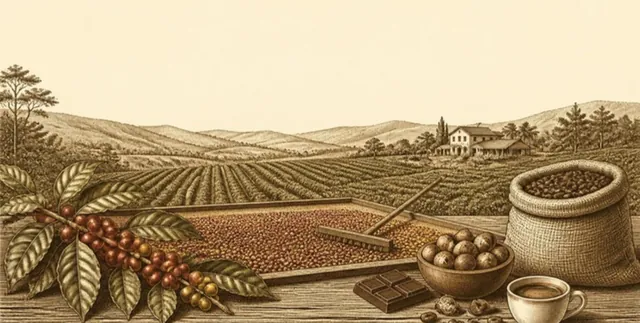
If an espresso tastes of cocoa, hazelnut and caramel, there is a good chance Brazil is in it. The country grows roughly a third of the world's coffee, from commodity coffee to small speciality lots that do well in competitions. For many roasters Brazil is the foundation: reliable, sweet and round. That is exactly why it is easy to underrate.
Where is coffee grown in Brazil?
Mostly in the south-east, in the state of Minas Gerais: in the Cerrado Mineiro, a wide high plateau with large, often machine-harvested farms, and in Sul de Minas, with hillier land and smaller farms. Then there is Mogiana in São Paulo, the Chapada Diamantina in Bahia and Espírito Santo, where a lot of Robusta grows alongside Arabica. On Bean Index, the regions roasters name most often are Minas Gerais, Cerrado and Sul de Minas.
Brazilian coffee usually grows lower than coffee from East Africa or Colombia. Where roasters state the altitude of a Brazilian coffee on Bean Index, the median is about 1,100 m. Lower farms and plenty of sun tend to give sweetness and body rather than lively acidity.
Catuai, Mundo Novo, Yellow Bourbon: which varieties grow there?
The most widespread are Catuai (red and yellow) and Mundo Novo, both Brazilian crosses from Bourbon and Typica lines. Popular with speciality roasters is Yellow Bourbon, with yellow cherries and a particularly sweet cup; newer varieties such as Arara or Acaiá are appearing too. Where roasters on Bean Index name a variety (for 87 Brazilian coffees), the most common are Catuai (49%), Mundo Novo (34%), Yellow Bourbon (15%), Bourbon (13%). Brazilian Robusta (Canephora) is often called Conilon and goes mainly into strong espresso blends.
Natural, pulped natural or washed?
Brazil is the country of naturals: the whole cherries dry in the sun on large patios or raised beds, and the fruit lends the bean sweetness and body. In a pulped natural (in Brazil, cereja descascado) the skin is removed but part of the fruit stays on the bean while it dries, much like a honey coffee from Central America. Washed Brazilian coffees exist but are rare. Among Brazilian coffees on Bean Index whose roaster states the process (n = 112), 85% are natural and 4% washed. How the methods differ is explained in natural vs washed coffee; to compare naturals from every origin, see natural process coffee.
What does Brazilian coffee taste like?
Roasters describe Brazilian coffees mostly with chocolate, cocoa, hazelnut, caramel and almond, sometimes with ripe red fruit, and with plenty of body and little bright acidity. For 73% of the Brazilian coffees on Bean Index the roasters' notes read as chocolate, and for 78% as nut and caramel. These are the roasters' words, read and grouped by AI, not a measurement. If you don't enjoy bright, tangy coffee, Brazil is a sensible place to start. More coffees like this: chocolatey and nutty coffees.
| What we count | Brazil |
|---|---|
| Coffees / roasters | 132 / 81 |
| Median price per kg | £45/kg (all single origins: £54/kg) |
| Natural / washed (process stated, n = 112) | 85% / 4% |
| Espresso roasts (brewing stated, n = 63) | 43% |
| Notes read as chocolate / nut and caramel | 73% / 78% |
| Median altitude stated | 1,100 m |
| Regions named most often | Minas Gerais, Cerrado and Sul de Minas |
Why is Brazil in so many espressos?
Because it fits: plenty of sweetness, a round body, chocolate, and acidity that doesn't turn sharp under pressure. With milk, in a flat white or a latte, a Brazil often tastes of hazelnut praline. Many roasters therefore use Brazil as the base of their espresso blends and add a fruitier coffee from Ethiopia or Colombia. Among Brazilian coffees on Bean Index whose roaster states what the roast is for (n = 63), 43% are roasted for espresso. For an espresso machine or a bean to cup machine, coffees like these are usually the safe choice; more in which coffee beans suit a bean to cup machine. Brazil is a common base for decaf too: 25 of the Brazilian coffees listed are decaffeinated (decaf coffee beans).
What does Brazilian coffee cost?
Brazil is one of the cheaper origins on Bean Index: large farms, efficient harvests and enormous volumes keep the price down. Top lots from small farms and competition coffees still cost a good deal more. On Bean Index, Brazil has a median of £45/kg, against £54/kg for all single origins (price per kg from the standard bag, checked 19 Oct 2026). That is the lowest median among the ten most common origins. The chart shows how the countries compare; what espresso beans cost in general is covered in affordable espresso beans.
| Origin | Range p10–p90 | Median | n |
|---|---|---|---|
| Colombia | £39–104/kg | £55/kg | 233 |
| Brazil | £36–63/kg | £45/kg | 116 |
| Ethiopia | £40–80/kg | £59/kg | 117 |
| Kenya | £42–68/kg | £58/kg | 75 |
| Guatemala | £40–74/kg | £55/kg | 68 |
| Peru | £42–74/kg | £58/kg | 55 |
| Costa Rica | £38–73/kg | £54/kg | 41 |
| Rwanda | £38–68/kg | £51/kg | 38 |
| Honduras | £38–70/kg | £53/kg | 38 |
| Mexico | £41–66/kg | £52/kg | 32 |
A lower price is not a sign of lower quality, and differences between countries also reflect which roasters buy which coffees. Why prices per kg vary so much is explained in how much speciality coffee costs per kg.
What we don't know
- How the coffee was harvested. Few roasters say whether it was picked selectively by hand or by machine.
- Whether a coffee is a pulped natural. Roasters label it differently: as pulped natural, as honey or simply as natural.
- How good a particular lot is. We don't check cupping scores or awards.
- How it tastes to you. Roast and brewing decide whether a Brazil tastes of cocoa or of cardboard.
Coffees from Brazil on Bean Index
Roastworks Coffee Co.Willand, UK
Brazil
Brazil, Minas Gerais, 1,150 m
Natural, Catuai
Dried fruit & spice, Chocolate, Nut & caramel
Filter roast
Price per kg £42.50/kg
£8.50 for 200 g, excl. delivery, checked
around the median for Natural from Brazil
To roasterThe Good Coffee CartelGlasgow, UK
Brazil, Sitio Penha
Brazil, Nova Resende, 1,110 m
Natural, Catuai
Dried fruit & spice, Nut & caramel
Espresso roast
Price per kg £40.00/kg
£8.00 for 200 g, excl. delivery, checked
9% below median for Natural from Brazil
To roasterUe Coffee RoastersWitney, UK
Brazil Aracacu Catucai Microlot
Brazil, Minas Gerais, 1,000–1,200 m
Natural, Catuai, Mundo Novo
Tropical & winey, Nut & caramel, Stone fruit
Omni roast
Price per kg £48.00/kg
£12.00 for 250 g, excl. delivery, checked
9% above median for Natural from Brazil
To roasterDear Green Coffee RoastersGlasgow, UK
Brazil - Fazenda Pantano - Pulped Natural
Brazil, Cerrado, 1,100 m
Honey, Yellow Bourbon
Berries, Nut & caramel
Omni roast
Price per kg £53.60/kg
£13.40 for 250 g, excl. delivery, checked
31% above median for Honey from Brazil
To roasterLost Horizon CoffeeBristol, UK
Seasonal Espresso - Samba Reserve Natural, Brazil
Brazil, Minas Gerais, 1,000–1,300 m
Natural, Mixed
Chocolate, Nut & caramel
Espresso roast
Price per kg £53.33/kg
£12.00 for 225 g, excl. delivery, checked
21% above median for Natural from Brazil
To roasterLost Sheep CoffeeWhitstable, UK
Brazil | Rich Nutty Toffee
Brazil, Paranaíba, 1,100 m
Natural, Catuai
Chocolate, Nut & caramel
Omni roast
Price per kg £52.50/kg
£10.50 for 200 g, excl. delivery, checked
19% above median for Natural from Brazil
To roasterAll coffees from Brazil · Brazil for espresso · Brazilian naturals
Sources & method
- Brazil's share of world production: International Coffee Organization, production statistics (ico.org).
- Growing regions, varieties and processing in Brazil: widely accepted knowledge from roaster and trade literature.
- Origin, region, variety, process, altitude and brewing: as stated by the roasters in their own shops; shares refer to coffees for which the field is stated. Rules: methodology.
- Flavour notes: read by AI from the roasters' descriptions, not a measurement.
- Figures: coffees on sale on Bean Index, n = 1,510, checked 19 Oct 2026. Prices excl. delivery.
This guide is also available in German: Kaffee aus Brasilien: Schokolade, Nuss und viel Espresso (Bohnenatlas)