Colombian coffee: from Huila to Pink Bourbon
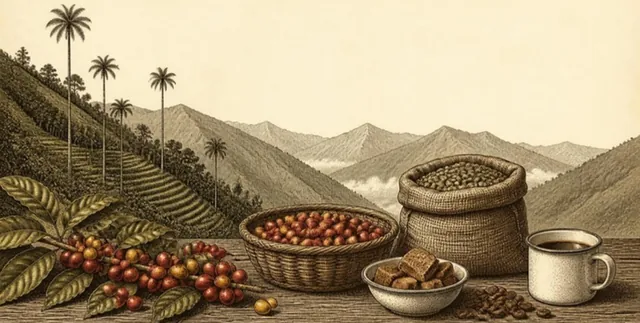
Colombia has an image problem that is really a compliment. Many people know the name from supermarket bags and file it under "reliable but dull". Speciality roasters show the opposite: Colombia sends out juicy Pink Bourbons, Geishas from small farms, anaerobic lots and a good share of the decaf that speciality roasters sell.
Where is coffee grown in Colombia?
Along the three Andean mountain ranges, on a great many small farms. The most familiar regions for speciality coffee lie in the south (Huila, Cauca and Nariño) and in the centre (Tolima, Quindío and Antioquia). The regions UK roasters name most often on Bean Index are Huila, Cauca and Tolima. Because Colombia lies close to the equator and its altitudes vary so much, some regions harvest twice a year: a main crop and a smaller one called the "mitaca". That is why fresh-crop Colombian coffee is available for most of the year.
Castillo, Caturra, Pink Bourbon: which varieties grow there?
Most farms grow Castillo and Colombia, hardy varieties bred by the national coffee research centre to resist coffee leaf rust, alongside the classic Caturra. The rarer varieties get the attention: Pink Bourbon, with pink cherries and often a floral, fruity cup, Geisha (also spelled Gesha), Tabi and Sidra. Where roasters on Bean Index name a variety (for 199 Colombian coffees), the most common are Caturra (44%), Castillo (42%), Pink Bourbon (12%), Gesha (11%). Why Geisha costs so much is explained in why is Geisha coffee so expensive?
What do Supremo and Excelso mean?
They are bean size grades, not a verdict on flavour: Supremo beans are the larger ones, Excelso beans a little smaller. On speciality coffee the bag usually names the farm, the region or the variety instead of the size grade, and that tells you more about the cup.
Washed, honey, anaerobic, infused
Traditionally Colombia is a country of washed coffees. Of the Colombian coffees on Bean Index whose roaster states the process (n = 225), 73% are washed and 20% natural. At the same time many farmers experiment: long fermentations without oxygen (anaerobic), or fermentation with added yeasts or fruit. 35 Colombian coffees on Bean Index are labelled anaerobic. Many roasters draw the line at infused coffees, where fruit, spices or flavourings are added during fermentation. They can taste strikingly of strawberry or cinnamon, but no longer only of coffee. 31 Colombian coffees on Bean Index are labelled infused; you can hide infused coffees in the catalogue. More in natural vs washed coffee.
Why does so much decaf come from Colombia?
Because one method suits the country well. Sugarcane (EA) decaf, also sold as "EA decaf" or "decaf de caña", takes the caffeine out with ethyl acetate made from fermented sugarcane. The beans keep much of their sweetness, which is why many roasters buy their speciality decaf from Colombia. 63 of the Colombian coffees on Bean Index are decaf. Each coffee page shows the decaf method when the roaster names it; how sugarcane compares with Swiss Water is explained in Swiss Water vs sugarcane decaf, and every decaf coffee is listed under decaf coffee beans.
What does Colombian coffee taste like?
Roasters describe classic washed Colombians with caramel, chocolate, red fruit and balanced acidity: a coffee most people get on with, and one that works as espresso and as filter. Pink Bourbons and Geishas lean towards florals, peach and citrus; anaerobic and infused lots towards tropical fruit, red wine and liqueur. For 19% of the Colombian coffees on Bean Index the roasters' notes read like berries, for 26% like citrus. Those are the roasters' words, read and grouped by AI. If you prefer something rounder, see chocolatey and nutty coffees.
How much does Colombian coffee cost?
The range is wide: a washed Castillo from a cooperative costs a fraction of a Pink Bourbon or a Geisha from a small farm. On Bean Index the median for Colombia is £55/kg, against £54/kg for all single origins (price per kg from the standard bag, checked 19 Oct 2026). The chart shows how the origins compare. For two other well-known origins, see Kenyan coffee and Ethiopian coffee.
| Origin | Range p10–p90 | Median | n |
|---|---|---|---|
| Colombia | £39–104/kg | £55/kg | 233 |
| Brazil | £36–63/kg | £45/kg | 116 |
| Ethiopia | £40–80/kg | £59/kg | 117 |
| Kenya | £42–68/kg | £58/kg | 75 |
| Guatemala | £40–74/kg | £55/kg | 68 |
| Peru | £42–74/kg | £58/kg | 55 |
| Costa Rica | £38–73/kg | £54/kg | 41 |
| Rwanda | £38–68/kg | £51/kg | 38 |
| Honduras | £38–70/kg | £53/kg | 38 |
| Mexico | £41–66/kg | £52/kg | 32 |
What we don't know
- How a fermentation actually went. We use "anaerobic" and "infused" as the roaster uses them; details about yeasts or additions are often missing.
- How good a particular lot is. We don't check cupping scores or awards.
- How it will taste to you. With Colombia in particular the range runs from house blend to fruit bomb, so read the roaster's notes.
Colombian coffees on Bean Index
The Roasting ShedLondon, UK
El Paraíso - Colombia
Colombia, Huila, 1,700–1,900 m
Washed, Variedad Colombia
Berries, Dried fruit & spice, Nut & caramel
Filter roast
Price per kg £62.50/kg
£12.50 for 200 g, excl. delivery, checked
14% above median for Washed from Colombia
To roasterArtisan RoastEdinburgh, UK
La Guaca
Colombia, Huila, 1,745 m
Natural, Bourbon Ají
Citrus, Berries, Dried fruit & spice
Filter roast
Price per kg £56.00/kg
£14.00 for 250 g, excl. delivery, checked
20% below median for Natural from Colombia
To roasterClifton Coffee RoastersBristol, UK
25th Anniversary Coffee - Colombia
Colombia, Huila, 1,650 m
Natural (anaerobic), Pink Bourbon
Floral & tea, Berries, Tropical & winey
Omni roast
Price per kg £190.91/kg
£21.00 for 110 g, excl. delivery, checked
Crankhouse CoffeeExeter, UK
Antuuka Manizales EA DECAF
Colombia, Caldas, 1,600–2,000 m
Washed, Castillo, Caturra
Citrus, Chocolate, Nut & caramel
Omni roast
Price per kg £44.00/kg
£11.00 for 250 g, excl. delivery, checked
12% below median for Decaf
To roasterNorthern CobblerBillesdon, UK
Char - DECAF
Colombia, Cauca, 1,700–1,900 m
Washed, Castillo, Colombia
Chocolate, Nut & caramel
Omni roast
Price per kg £131.82/kg
£29.00 for 220 g, excl. delivery, checked
164% above median for Decaf
To roasterOddKin CoffeeBristol, UK
El Diviso, Colombia (Experimental Decaf)
Colombia, Huila, 1,850 m
Natural (anaerobic), Ombligon
Floral & tea
Omni roast
Price per kg £102.50/kg
£20.50 for 200 g, excl. delivery, checked
105% above median for Decaf
To roasterAll coffees from Colombia · Colombia, washed · Colombia, decaf
Sources & method
- Growing regions, varieties, size grades, processing and decaffeination in Colombia: generally accepted knowledge from roasters' and trade literature.
- Origin, region, variety, process, anaerobic, infused and decaf: as stated by the roasters in their own shops; shares refer to the coffees for which the field is stated. Rules: methodology.
- Flavour notes: read by AI from the roasters' descriptions, not a measurement.
- Bean Index figures: coffees on sale, n = 1,510, checked 19 Oct 2026.
This guide is also available in German: Kaffee aus Kolumbien: von Huila bis Pink Bourbon (Bohnenatlas)