Geisha (Gesha) coffee: why is it so expensive?
Where does Geisha come from?
The name goes back to Gori Gesha, a forest area in south-west Ethiopia. Seeds of wild coffee were collected in Ethiopia's coffee forests in the 1930s and sent to the Lyamungu research station in Tanzania. In 1953 the variety reached CATIE, the agricultural research centre in Costa Rica, where it was logged as accession T2722. From there it was handed out to farms in Panama in the 1960s, valued for its tolerance of coffee leaf rust. Farmers did not like its brittle branches and low yield, so for decades hardly anyone planted it.
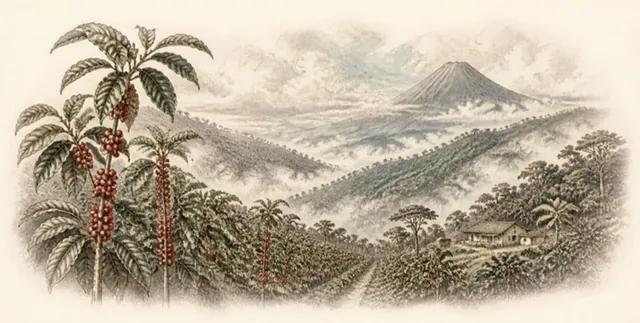
That changed in the early 2000s. In 2004 a Geisha from Hacienda La Esmeralda, the Peterson family's farm in Boquete, Panama, astonished the jury of the Best of Panama competition, and the lot sold at auction for a record price for green coffee at the time. (World Coffee Research dates the record auction to 2005; most accounts put the competition win in 2004.) Since then "Panama Geisha" has stood for some of the most sought-after coffee in the world. Well-known farms lie in the province of Chiriquí, around Boquete and Volcán on the slopes of the Barú volcano.
On spelling: "Gesha" is closer to the place name, "Geisha" is far more common in searches and on bags. The name has nothing to do with Japan. Bean Index calls the variety "Geisha (Gesha)", and the search finds both.
What does Geisha taste like?
Geisha is known for a floral, tea-like profile. Typical notes are jasmine, bergamot, citrus, peach and black tea, with a light, almost delicate body. That is how the trade has described it for years.
In Bean Index, roasters most often describe Geisha with floral & tea, stone fruit and citrus. That is based on 25 Geisha coffees with flavour notes, read by AI from the roasters' words. The most common process is washed (52% of Geishas with a stated process).
Geisha is a plant, not a flavour, though. Altitude, process and roast decide as much as the variety. A washed Geisha is often described as clear and floral, a natural as fruitier and sweeter, an anaerobic one as something else again; see natural vs washed: how they taste. To keep the delicate florals, most roasters roast Geisha light and suggest it for filter. In a V60 or other pour-over it shows clearly; as espresso a light Geisha can taste sharp, and dialling in a small bag on an espresso machine costs beans.
Why does Geisha cost more?
Several reasons come together:
- Yield. World Coffee Research rates the yield potential of Panamanian Geisha as low. Each hectare gives less coffee than many other varieties.
- Growing. Geisha is often grown high up on small plots and picked by hand, selectively, cherry by cherry.
- Small lots. Many Geishas are processed and sold in small, separate lots.
- Auctions and demand. Competitions and auctions set reference prices. The name is known, the supply is small.
In Bean Index the median Geisha costs £100/kg, 85% above the median of all single origins (£54/kg). Four out of five Geishas cost between £56 and £151/kg. The range is wide: a Geisha from Colombia or Peru can be much cheaper than an auction lot from Panama.
A high price does not guarantee you will like a Geisha; only your cup can tell you whether it is worth it. If you are curious but don't want to spend much, start from the lower end of the range or with a small bag. Compare the price per kg, not the bag price: for a 100 g bag the price per kg is ten times the bag price, for a 250 g bag four times. What speciality coffee costs in general is in how much speciality coffee costs per kg.
Is Geisha the most expensive coffee in the world?
Not as a variety. Headlines about "the world's most expensive coffee" usually mean single auction lots: at competitions such as Best of Panama, small amounts of Geisha fetch many times the usual price. In UK shops the range is wide. In Bean Index the cheapest tenth of Geishas costs less than £56/kg, the dearest tenth more than £151/kg (n = 25 Geishas with a price, checked 19 Oct 2026). Geisha is expensive compared with most varieties, but the record prices belong to single lots, not to every Geisha.
Where do the Geishas sold in the UK come from?
Geisha is now grown in many countries. Panama made it famous; Colombia, Peru, Ecuador and Costa Rica grow it too. In Ethiopia, its homeland, the name appears less often: most Ethiopian coffees come from local landraces sold as "heirloom" or "Ethiopian landrace".
This is where the Geishas in Bean Index come from (checked 19 Oct 2026):
- Colombia: 18 coffees
- Peru: 6 coffees
- Costa Rica: 2 coffees
- Guatemala: 2 coffees
- El Salvador: 1 coffee
- Honduras: 1 coffee
- Mexico: 1 coffee
- Tanzania: 1 coffee
- origin not stated by the roaster: 1
The list shows what the roasters in Bean Index are selling right now, not how much each country grows.
What should you check before buying?
- Price per kg, not bag price. Small bags make comparison hard.
- Process. Washed, natural and anaerobic Geishas taste very different.
- Origin and altitude. Where the roaster states them, they are in the coffee facts; where not, we say "not stated by the roaster".
- Pure Geisha or a mix. Sometimes Geisha is one of several varieties in a lot. Then the coffee facts list several varieties, and the coffee often costs less.
- The claim itself. The roaster names the variety, usually on the farm's word. We cannot check it.
Geishas often sell out quickly. When yours is gone, the replacement finder shows coffees with a similar profile. All Geishas on sale are on the Geisha coffee beans page.
What we don't know
- Whether every Geisha is genetically Geisha. World Coffee Research notes that several distinct types have been sold under the name. We rely on what the roaster states.
- Auction prices. We list retail prices of roasted coffee from UK roasters, not green-coffee auction results.
- Harvest differences. Even from the same farm, each harvest tastes a little different; flavour notes are the roaster's description of one lot.
Geisha coffees in Bean Index
Carnival Coffee RoastersLondon, UK
Filter - Finca Morales, Peru - Lychees - Blueberry - Jasmine
Peru, Amazonas, 1,900 m
Natural (anaerobic), Gesha
Floral & tea, Berries, Tropical & winey
Filter roast
Price per kg £117.17/kg
£26.95 for 230 g, excl. delivery, checked
17% above median for Gesha (Geisha)
To roasterCast Iron Coffee RoastersChichester, UK
Andy Llanos, Geisha
Peru, Cajamarca, 1,820 m
Washed, Gesha
Floral & tea, Citrus, Tropical & winey
Omni roast
Price per kg £147.06/kg
£50.00 for 340 g, excl. delivery, checked
47% above median for Gesha (Geisha)
To roasterClifton Coffee RoastersBristol, UK
Gesha - Wilton Benitez
Colombia, Cauca, 1,900 m
Washed (anaerobic), Gesha
Floral & tea, Citrus, Tropical & winey
Omni roast
Price per kg £166.67/kg
£20.00 for 120 g, excl. delivery, checked
Artisan RoastEdinburgh, UK
Don Jaime Gesha
El Salvador, Chalatenango, 1,650 m
Natural (anaerobic), Gesha
Citrus, Berries, Tropical & winey
Price per kg £72.00/kg
£18.00 for 250 g, excl. delivery, checked
28% below median for Gesha (Geisha)
To roasterBlack Mountain RoastMichaelchurch Escley, UK
Gesha – Medium Roast – Colombian Coffee Beans & Ground Coffee
Colombia, Tolima, 1,500–2,000 m
Washed, Gesha
Floral & tea, Chocolate, Stone fruit
Price per kg £54.00/kg
£13.50 for 250 g, excl. delivery, checked
46% below median for Gesha (Geisha)
To roasterCarnival Coffee RoastersLondon, UK
Carnival Curiosities - Efraín Gómez, Colombia - Cherry - Kiwi - Popping Candy
Colombia, Nariño, 2,001 m
Washed (anaerobic), Gesha
Tropical & winey, Stone fruit
Price per kg £99.78/kg
£22.95 for 230 g, excl. delivery, checked
around the median for Gesha (Geisha)
To roasterSources & method
- Variety: stated by the roasters in their shops; "Geisha" and "Gesha" count as one variety. A coffee counts as Geisha when Geisha is in its name, is the only variety, or comes first of at most two; blends of many varieties with some Geisha do not count. Cascara and other non-coffee products are excluded.
- Prices: price per kg from the standard bag (200 to 350 g), coffees currently on sale, checked 19 Oct 2026. Prices in other currencies converted at the ECB reference rate of 19 Oct 2026. Ranges run from the cheapest to the dearest tenth, not from the single cheapest to the single dearest coffee: single values at the edges are often special cases.
- Flavour notes: read by AI from the roasters' descriptions, not a measurement.
- History, accession T2722, yield and genetic types: World Coffee Research, Coffee Varieties Catalog, entry Geisha (Panama).
- Gori Gesha, Hacienda La Esmeralda and Best of Panama 2004: Chris Ryan, The Rise of Gesha, Barista Magazine, 2018.
This guide is also available in German: Geisha (Gesha): Herkunft, Geschmack und warum sie so viel kostet (Bohnenatlas)