Swiss Water vs sugarcane decaf: what's the difference?
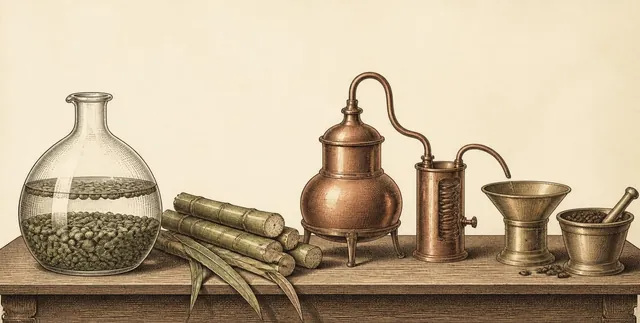
"Swiss Water" is the decaf name most people know, but it is only one of several methods UK speciality roasters use. Sugarcane and Swiss Water decaf can both make a good cup; the difference lies in what takes the caffeine out of the bean, where that happens and what the roaster tells you about it.
How is coffee decaffeinated?
Every method works on green, unroasted coffee. The beans are moistened or steamed so the caffeine can move, the caffeine is drawn out with a solvent, water or carbon dioxide, and the beans are dried again before they are shipped to the roaster. The challenge is to take the caffeine and leave the sugars, acids and aroma precursors that roasting turns into flavour. Decaf is then roasted like any other coffee.
What is sugarcane (EA) decaf?
Sugarcane decaf, also sold as "EA decaf" or "decaf de caña", uses ethyl acetate. Ethyl acetate is an ester that also occurs naturally in fruit; here it is made from sugarcane that is fermented to ethanol and then turned into ethyl acetate. Roasters selling it usually describe the same steps: the green beans are steamed, soaked in an ethyl acetate solution several times until the caffeine is gone, then steamed again to drive off the solvent. Most say it is done in Colombia, near where the coffee is grown.
Roasters often describe sugarcane decafs as sweet and fruity. Those are the roasters' words, read and grouped by AI in Bean Index, not a test of ours. EU food law lists ethyl acetate among the extraction solvents allowed for all uses under good manufacturing practice.
What are Swiss Water and Mountain Water decaf?
Swiss Water is a proprietary method from Swiss Water Decaffeinated Coffee in British Columbia, Canada, despite the name. Green coffee is soaked in water that is already saturated with green-coffee solubles, so mainly the caffeine moves out; carbon filters then take the caffeine out of that water, and it is used again. The company says it never uses chlorinated solvents or esters.
Mountain Water is the comparable water method from Descamex in Veracruz, Mexico. Roasters describe it as using water from the Pico de Orizaba and carbon filtration, without solvents.
What about CO₂ and DCM decaf?
CO₂ decaf uses carbon dioxide under high pressure, which behaves partly like a liquid and dissolves caffeine selectively. Carbon dioxide is, like ethyl acetate, on the EU list of solvents allowed for all uses.
DCM decaf uses dichloromethane (methylene chloride), a solvent long used for commodity decaf. EU rules allow it for decaffeinating coffee with a residue limit of 2 mg per kg of roasted coffee.
In Bean Index no roaster names DCM. That does not mean no DCM decaf is on sale: when a roaster does not state the method, we show "not stated by the roaster" and do not guess.
| Method | What takes the caffeine out | Where it is usually done | Typical wording on UK bags |
|---|---|---|---|
| Sugarcane (EA) | ethyl acetate from fermented sugarcane | Colombia, near origin | "sugarcane decaf", "EA", "decaf de caña" |
| Swiss Water | water saturated with green-coffee solubles, carbon filters | British Columbia, Canada | "Swiss Water Process", "SWP" |
| Mountain Water | water and carbon filters | Veracruz, Mexico | "Mountain Water Process", "MWP" |
| CO₂ | pressurised carbon dioxide | specialised industrial plants | "CO₂ decaf", "supercritical CO₂" |
| DCM | dichloromethane (methylene chloride) | large industrial plants | rarely named; often just "decaf" |
Which decaf method do UK roasters use?
The chart counts every decaf coffee in Bean Index by the method its roaster names in the shop: in the product title, the process field or the description. Each coffee counts once. "Not stated" means the roaster gives no method we could find.
Median price per kg: decaf £50/kg (144 coffees with a price), all other coffees £51/kg (1,226)
Decaf is not a budget shelf in speciality coffee: the line under the chart compares the median price per kg of decaf with all other coffees. Many decafs are single origins with a farm, a variety and a process like any other lot; see natural vs washed: how they taste for what the process name tells you.
How much caffeine is left in decaf?
Decaf is not caffeine-free; a small amount always remains. For instant coffee, UK law sets the figure: under the Coffee Extracts and Chicory Extracts (England) Regulations 2000, and the equivalent 2001 rules for Wales, a coffee extract may be called "decaffeinated" only if its residual anhydrous caffeine does not exceed 0.30% of the coffee-based dry matter.
For roasted beans we found no UK statute with a limit. The figure of 0.1% often quoted for decaf beans comes from national rules elsewhere, such as Germany's Kaffeeverordnung, which allows "entkoffeiniert" only for roasted or green coffee with at most 1 g of caffeine per kg of coffee dry matter.
A cup of decaf therefore still contains a little caffeine. If you have to avoid caffeine completely, decaf is not a guarantee.
How do you choose a decaf?
- Taste first, method second. Origin, process and roast shape a decaf's flavour as much as the method does.
- Look for the method on the page. A roaster who names it usually also names the farm and the process.
- For espresso, filter the catalogue for decaf espresso beans; for milk drinks, chocolatey and nutty notes tend to sit better than very fruity ones.
- Buy small. If you drink decaf only in the evening, a smaller bag stays fresher.
What we don't know
- How much caffeine a given bag contains. We do not measure caffeine; roasters rarely state it.
- The method behind "not stated". We read the method from the roaster's own words and do not infer it from origin or price.
- Whether one method tastes better. We have run no tastings. Flavour notes are the roasters' words, read by AI.
Decaf coffees in Bean Index
Crankhouse CoffeeExeter, UK
Antuuka Manizales EA DECAF
Colombia, Caldas, 1,600–2,000 m
Washed, Castillo, Caturra
Citrus, Chocolate, Nut & caramel
Omni roast
Price per kg £44.00/kg
£11.00 for 250 g, excl. delivery, checked
12% below median for Decaf
To roasterHorsham Coffee RoasterBurgess Hill, UK
Coffee Bird Decaf
Guatemala, Acatenango, 1,500 m
Washed, Bourbon, Caturra
Berries, Chocolate, Nut & caramel
Filter roast
Price per kg £51.00/kg
£12.75 for 250 g, excl. delivery, checked
around the median for Decaf
To roasterNorthern CobblerBillesdon, UK
Char - DECAF
Colombia, Cauca, 1,700–1,900 m
Washed, Castillo, Colombia
Chocolate, Nut & caramel
Omni roast
Price per kg £131.82/kg
£29.00 for 220 g, excl. delivery, checked
164% above median for Decaf
To roasterOddKin CoffeeBristol, UK
El Diviso, Colombia (Experimental Decaf)
Colombia, Huila, 1,850 m
Natural (anaerobic), Ombligon
Floral & tea
Omni roast
Price per kg £102.50/kg
£20.50 for 200 g, excl. delivery, checked
105% above median for Decaf
To roasterPharmacie Coffee RoastersLewes, UK
DECAF Happy Capybara, Brazil Espresso Roast
Brazil, Minas Gerais, 900 m
Natural, Catuai, Mundo Novo
Dried fruit & spice, Chocolate, Nut & caramel
Espresso roast
Price per kg £44.00/kg
£11.00 for 250 g, excl. delivery, checked
12% below median for Decaf
To roasterThe Good Coffee CartelGlasgow, UK
Colombia, Decaf De Cana
Colombia, Huila, 1,400–2,000 m
Washed, Castillo, Caturra
Citrus, Chocolate, Nut & caramel
Espresso roast
Price per kg £50.00/kg
£10.00 for 200 g, excl. delivery, checked
around the median for Decaf
To roasterSources & method
- Instant coffee limit: The Coffee Extracts and Chicory Extracts (England) Regulations 2000, SI 2000/3323, regulation 5; The Coffee Extracts and Chicory Extracts (Wales) Regulations 2001, SI 2001/1440 (W.102).
- Roasted coffee limit in Germany: Kaffeeverordnung 2001, § 2(3), gesetze-im-internet.de.
- Extraction solvents (ethyl acetate and CO₂ for all uses; dichloromethane for decaffeination, 2 mg/kg in roasted coffee): Directive 2009/32/EC, Annex I, text on legislation.gov.uk.
- Methods: Swiss Water Decaffeinated Coffee, Our process; Descamex, descamex.com.mx; descriptions of sugarcane and Mountain Water decaf from UK roasters' product pages. All read October 2026.
- Decaf method according to the roaster: only when the shop names it (title, process field or description), see the methodology. Bean Index figures: available coffees, n = 1,510, checked 19 Oct 2026.